The Role of Software Audits in Enterprise Governance
สรุปสั้น:
- Software audits verify compliance, identify security risks, and uncover cost inefficiencies within organizations. They have evolved into strategic tools that inform governance, cloud migration, and vendor decisions, helping businesses reduce legal and security risks. Proactive, continuous audit practices improve negotiation leverage, lower disruption, and prevent hidden compliance and technical debt costs.
A software audit is a systematic evaluation of an organization’s software environment to verify compliance, identify security vulnerabilities, and expose cost inefficiencies. The role of software audits extends far beyond checking license counts. Audits replace internal assumptions with verified data on architecture, workflows, license management, and security posture. The financial stakes are real. 45% of organizations have spent over $1 million on software audits in the past three years, which shows how costly poor visibility can become. Regulations like GDPR, HIPAA, and financial oversight frameworks make compliance audits not optional but necessary for any organization managing sensitive data or complex software estates.
What roles do software audits fulfill in compliance, security, and cost control?
Software audits fulfill three core roles: enforcing compliance, reducing security risk, and cutting wasted IT spend. Each role addresses a different type of organizational exposure, and all three tend to surface findings that leadership did not expect.
Compliance and regulatory risk
Compliance violations carry serious financial consequences. Fines for software misuse and licensing violations can range from thousands to millions of dollars, depending on the regulatory framework. GDPR and HIPAA both carry penalty structures that scale with the severity and duration of the violation. A software compliance audit maps actual usage against license agreements and regulatory requirements, identifying gaps before a regulator or vendor does. Organizations that rely on software validation practices as part of their audit cycle close those gaps faster and with less disruption.

Security vulnerability detection
Security audits examine software configurations, patch levels, access controls, and third-party dependencies. Unpatched software and misconfigured tools are among the most common entry points for data breaches. A structured audit surfaces these exposures in a way that internal teams, operating under daily workload pressure, often miss. Secure software practices reduce breach risk and help organizations avoid the compounding costs of incident response, legal liability, and reputational damage.
Cost efficiency and license optimization
Software audits uncover hidden inefficiencies such as unused licenses and overlapping tools, enabling direct cost savings. This matters because technical debt consumes 20%–40% of an enterprise’s total IT budget. That is a significant drag on resources that could fund new capabilities. Audits give procurement and IT teams the data they need to eliminate redundant subscriptions, renegotiate contracts, and reallocate budget toward higher-value tools.
Here is what a well-executed audit typically uncovers:
- ✅ Unused or underused software licenses that can be reclaimed or canceled
- ✅ Overlapping tools performing the same function across departments
- ✅ Unlicensed software creating compliance and security exposure
- ✅ Outdated software versions with known vulnerabilities
- ✅ Misaligned license tiers where teams pay for features they never use
คำแนะนำจากผู้เชี่ยวชาญ: Run a license reconciliation report at least 90 days before any major contract renewal. You will have time to act on findings rather than just document them.
How has the role of software audits evolved into a strategic governance tool?
The role of software audits has shifted from reactive IT hygiene to a decision-enabling function embedded in enterprise governance. This shift is not cosmetic. It reflects a fundamental change in how leadership uses audit findings.
“A key function of audits is to replace internal assumptions with objective facts, enabling timely and accurate decisions across departments.” — Software Audit Guide for Enterprises
Ten years ago, most organizations treated audits as periodic cleanup exercises. A vendor would send a notice, IT would scramble to gather data, and the result was usually a settlement or a rushed license purchase. That reactive model is expensive and puts organizations at a structural disadvantage. The modern approach treats audit readiness as a continuous governance function, not a fire drill.
Enterprises now use software audits as tools for governance, guiding strategic decisions including cloud adoption, vendor rationalization, and modernization efforts. This means audit findings feed directly into budget planning, vendor negotiations, and technology roadmaps. When a CIO knows exactly which tools are used, by whom, and at what cost, the conversation about cloud migration or platform consolidation becomes grounded in fact rather than opinion.
The strategic evolution also changes what audits prioritize. Compliance counts still matter, but the most valuable audits rank findings by business impact. A licensing gap in a low-usage legacy tool is a lower priority than a security misconfiguration in a customer-facing platform. This business-impact lens is what separates a governance-grade audit from a basic compliance check.
Key ways audits now serve strategic decision-making:
- Cloud migration planning: Audit findings identify which on-premise licenses have cloud equivalents and which contracts restrict cloud deployment.
- Vendor rationalization: Overlapping tool data gives procurement teams leverage to consolidate vendors and reduce total spend.
- Modernization roadmaps: Technical debt findings from audits directly inform which systems to retire, replace, or upgrade.
- Executive reporting: Audit data provides leadership with a credible, defensible view of IT risk and investment efficiency.
What triggers software audits, and how can you manage those triggers proactively?
Software audits do not happen randomly. Vendor audit selection relies on signals such as contract renewals and technology changes rather than random sampling. Understanding those signals lets you prepare before a vendor initiates the process.
The most common audit triggers include:
- Contract renewals. Vendors review usage data ahead of renewal to identify under-licensed deployments. This is the single most predictable trigger.
- Mergers and acquisitions. License agreements often restrict software use by legal entity. When two organizations merge, existing contracts may not cover the combined entity, creating immediate compliance exposure.
- Cloud migrations. Moving workloads from on-premise to cloud environments can violate license terms that specify deployment type or geographic location.
- Significant headcount growth. Rapid hiring often outpaces license procurement, creating gaps that vendors can detect through usage telemetry.
- Technology platform changes. Switching operating systems, virtualization platforms, or database engines can trigger license metric changes that require reassessment.
Mergers, acquisitions, and cloud migrations trigger hidden license compliance risks because contracts often restrict software use by entity or environment. Organizations that ignore this during due diligence inherit compliance liabilities that can cost far more than the deal synergies they expected to capture.
The proactive approach is straightforward. Organizations that conduct compliance checks before contract renewals gain better negotiating leverage than those responding to vendor-initiated audits. When you know your position before the vendor does, you control the conversation. You can address gaps quietly, reclaim unused licenses, and enter renewal discussions from a position of strength rather than defense.
คำแนะนำจากผู้เชี่ยวชาญ: Build a pre-renewal compliance review into your procurement calendar 120 days before any major software contract expires. Pair it with a review of your software renewal management process to capture savings before the vendor sets the terms.
Vendor intelligence also matters. Sophisticated vendors track deployment signals, support ticket volume, and usage telemetry. They know when you are likely out of compliance before you do. Treating audit readiness as a year-round discipline, rather than a response to a vendor letter, is the only reliable way to stay ahead of that information asymmetry.
What are the best practices for audit readiness and maximizing audit value?
Audit readiness is an organizational capability, not a one-time project. Audit readiness requires validated, centralized data and cross-departmental collaboration. Scrambling to gather data after receiving an audit notice increases risk and disruption significantly.
The foundation of readiness is a centralized, accurate software asset inventory. This means IT, procurement, legal, and finance all working from the same data set. When each department maintains its own records, discrepancies are inevitable. Those discrepancies become liabilities during an audit.
Continuous governance vs. one-off audits
| Approach | Characteristics | ผลลัพธ์ทางธุรกิจ |
|---|---|---|
| One-off audit | Triggered by vendor notice or compliance event | Reactive, high disruption, limited leverage |
| Periodic audit | Scheduled annually or semi-annually | Better than reactive, but gaps still accumulate |
| Continuous governance | Embedded in procurement and IT cycles | Lowest risk, best negotiating position, highest ROI |
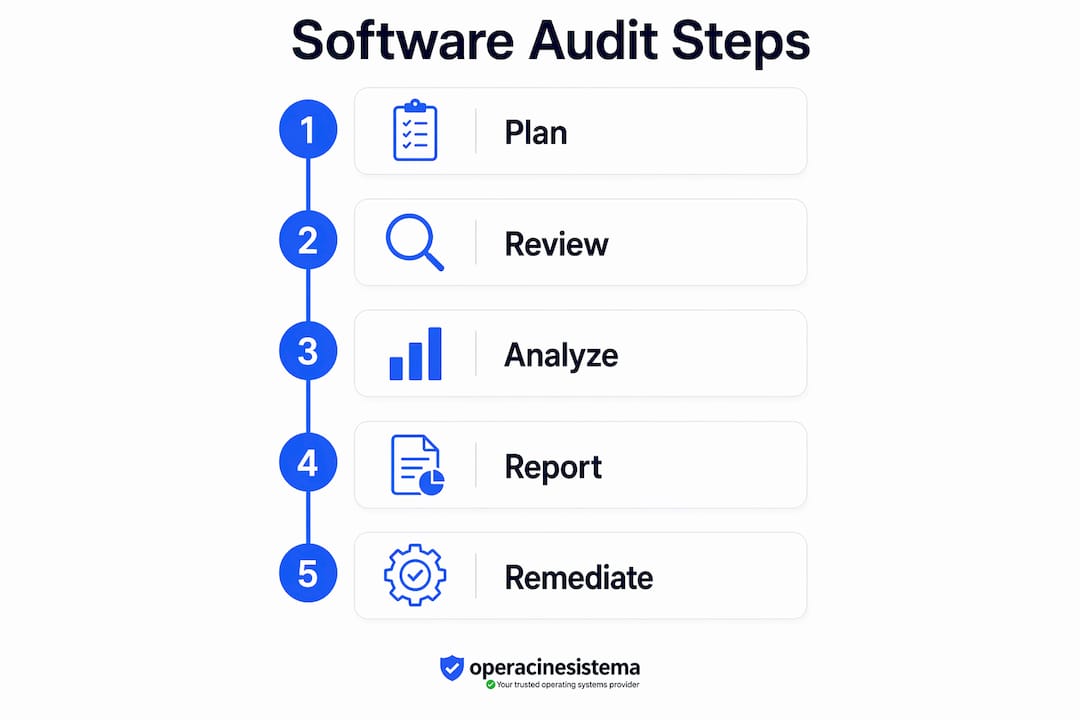
The most effective audits are continuous, embedded into governance cycles with remediation phases prioritized to translate insights into action. The remediation phase is where audits deliver their actual value. Findings without follow-through are just documentation.
Cross-departmental friction is the most common barrier to audit readiness. IT owns the technical data. Procurement owns the contracts. Legal owns the compliance obligations. Finance owns the budget. When these teams do not share a common data platform and clear ownership model, audit preparation becomes a coordination failure. Assigning a single audit program owner with authority across all four functions resolves most of this friction.
Best practices for building continuous audit readiness:
- ✅ Maintain a live software asset inventory updated with every new purchase, deployment, or decommission
- ✅ Assign clear ownership for each software category across IT, procurement, and legal
- ✅ Schedule quarterly license reconciliation reviews, not just annual ones
- ✅ Document all software deployments at the time of installation, not retrospectively
- ✅ Build remediation tracking into your audit process so findings translate into closed actions
Software audits bring together cross-functional teams because they expose issues spanning IT, procurement, legal, and finance. Organizations that treat this cross-functional requirement as a feature rather than a burden build stronger governance capabilities over time. The audit process itself becomes a mechanism for breaking down departmental silos.
Software licensing best practices provide a practical framework for maintaining the kind of clean, centralized records that make audit readiness achievable without heroic effort.
ประเด็นสำคัญ
Software audits are the most reliable mechanism organizations have for replacing assumption-based IT management with verified, decision-ready data across compliance, security, and cost control.
| จุด | รายละเอียด |
|---|---|
| Audits prevent costly violations | Compliance fines under GDPR and HIPAA can reach millions, making proactive audits far cheaper than reactive penalties. |
| Technical debt is a measurable risk | Technical debt consumes 20%–40% of enterprise IT budgets, and audits are the primary tool for quantifying and addressing it. |
| Audit triggers are predictable | Contract renewals, mergers, and cloud migrations are the top triggers; proactive preparation before these events improves your negotiating position. |
| Continuous governance beats one-off audits | Embedding audits into ongoing governance cycles produces better commercial outcomes and lower disruption than event-driven responses. |
| Remediation is where value is created | Audit findings only deliver business value when paired with a structured remediation phase that closes identified gaps. |
Why software audits deserve a permanent seat at the governance table
From where I sit at Jewels by ARES, the parallel between what we do and what a well-run software audit accomplishes is clearer than it might first appear. We build every piece with verified materials, documented craftsmanship, and a clear standard of quality. We do not guess at what went into a bracelet. We know. That same discipline, knowing exactly what you have, where it came from, and whether it meets your standard, is exactly what software audits deliver to an organization.
What strikes me most about the research on this topic is how consistently organizations underestimate the hidden costs of not auditing. Technical debt quietly consuming 40% of an IT budget does not announce itself. Unused licenses do not send invoices labeled “waste.” Compliance gaps do not surface until a vendor or regulator forces the issue. Audits make the invisible visible, and that visibility is what leadership needs to make confident decisions.
The organizations that treat audits as a continuous governance function rather than a periodic obligation are the ones that negotiate from strength, modernize with confidence, and avoid the financial surprises that derail IT budgets. That is not a theoretical benefit. It is a measurable operational advantage.
My honest view: most organizations are one contract renewal or one acquisition away from a compliance exposure they did not know existed. The fix is not complicated. It is consistent, disciplined, and worth every hour invested.
— Jewels by ARES
Quality and clarity go hand in hand
At Jewels by ARES, we believe that knowing exactly what you have is the foundation of genuine value. Whether that means verified diamonds in a diamond string bracelet or verified software compliance in your IT environment, the principle is the same: clarity protects what matters most. Our handcrafted pieces are built with the same commitment to transparency and quality that the best-run organizations bring to their software governance. When you invest in something meaningful, you want to know it is real, reliable, and worth it. That is what we deliver at Jewels by ARES, and it is what a well-executed software audit delivers to your organization.
คำถามที่พบบ่อย
What is the role of software audits in an organization?
A software audit is a systematic review of an organization’s software usage, licenses, security posture, and compliance status. Its core role is to replace internal assumptions with verified data that supports compliance, cost control, and governance decisions.
Why do software audits matter for compliance?
Software compliance audits identify licensing violations and regulatory gaps before vendors or regulators do. Fines under frameworks like GDPR and HIPAA can reach millions of dollars, making proactive audits a direct financial protection measure.
What triggers a software audit?
The most common audit triggers are contract renewals, mergers and acquisitions, cloud migrations, and significant headcount growth. Vendors use these signals to identify organizations likely to have compliance gaps.
How often should organizations conduct software audits?
The most effective approach is continuous governance with quarterly license reconciliation reviews rather than annual one-off audits. Embedding audits into ongoing procurement and IT cycles reduces risk and improves negotiating leverage.
What is the most important phase of a software audit?
Remediation is the most critical phase. Audit findings only deliver business value when organizations act on them through a structured process that closes compliance gaps, reclaims unused licenses, and addresses security vulnerabilities.
แนะนำ
- Why Verify Software Vendors: Security and Compliance Guide
- การตรวจสอบความถูกต้องของซอฟต์แวร์: บทบาทสำคัญในการปฏิบัติตามข้อกำหนดและการออกใบอนุญาต
- ทำไมความถูกต้องของซอฟต์แวร์จึงมีความสำคัญสำหรับธุรกิจขนาดเล็กในปี 2026
- แนวทางปฏิบัติที่ดีที่สุดในการใช้ลิขสิทธิ์ซอฟต์แวร์เพื่อการปฏิบัติตามกฎระเบียบและประหยัดค่าใช้จ่าย