How to Choose a Software License: A 2026 Guide
TL;DR:
- Choosing the right software license depends on your organization’s goals, such as maximizing adoption or ensuring openness. Permissive licenses like MIT and Apache 2.0 offer broad usage rights, with Apache 2.0 providing explicit patent protection; copyleft licenses like the GPL and AGPL guarantee that derivative works remain open source, especially for SaaS deployments. Conducting a dependency audit and clearly defining your licensing objectives are critical steps to ensure legal compliance and align with your business strategy.
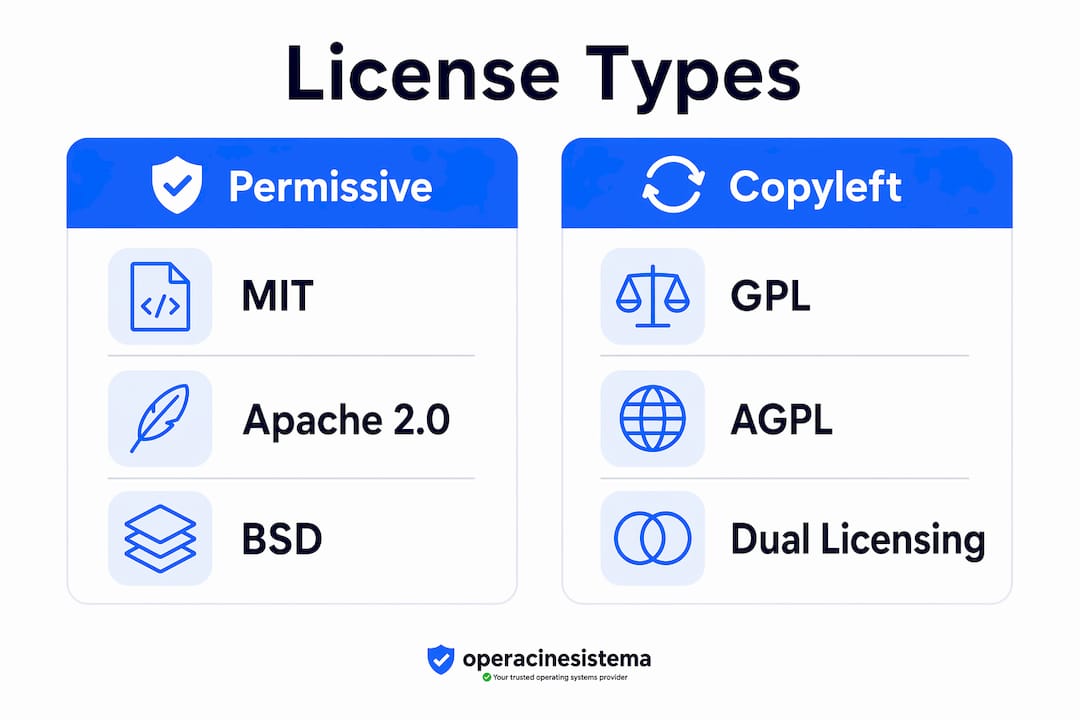
A software license is a legal document that specifies who can use, modify, and distribute your software, and under what conditions. Knowing how to choose software license terms that suit your organization is essential. The wrong choice can hinder adoption, expose you to patent litigation, or force you to make source code open source that you intended to keep private. Software Licensing in 2026 It falls into two main categories: permissive licenses such as MIT, Apache 2.0, and BSD, and copyleft licenses such as GPL and AGPL. Each category serves a different business objective. Your job is to choose a license that aligns with your goals, not the other way around.
What are the main types of software licenses and their implications for business?
Permissive and copyleft licenses represent the two extremes of the open-source spectrum, and understanding them is the first step in selecting software licenses that are right for your organization.
Permissive licenses: MIT, Apache 2.0, and BSD
Permissive licenses place minimal restrictions on how others use your software. Anyone can take your code, modify it, and include it in a proprietary product without having to release their changes. The MIT license is the most widely used permissive license because of its simplicity. The Apache 2.0 license adds one critical feature that the MIT license lacks: an explicit patent grant.

Apache 2.0 includes patent grants that protect contributors and users from patent litigation. If your project involves patentable technology, the Apache 2.0 license is the safer choice than the MIT license. BSD licenses come in two- and three-clause versions and are functionally similar to the MIT license, though they are less common in new projects.
Copyleft licenses: GPL and AGPL
Copyleft licenses require that any derivative work be released under the same license. The GNU General Public License (GPL) is the most widely recognized copyleft license. It ensures that modified versions of your software remain open source. This protects contributions from the community but limits commercial adoption by companies that cannot release their proprietary code.
AGPL v3 closes the SaaS loophole that the standard GPL leaves open. Under the GPL, a company can run your software on a server without releasing modifications because no distribution takes place. The AGPL requires source code disclosure even for server-hosted software. This makes the AGPL the right choice for projects where SaaS deployment is a concern.
Dual Licensing as a Revenue Strategy
Dual licensing allows companies to release software under a copyleft license for the community while selling a proprietary license to commercial users who cannot comply with copyleft terms. This balances community trust with revenue generation. It is a proven model used by database and infrastructure projects worldwide.
| License | Type | Patent Grant | Copyleft | Best For |
|---|---|---|---|---|
| MIT | Permissive | From | From | Maximum adoption, simple projects |
| Apache 2.0 | Permissive | Yes | From | Projects involving patentable technology |
| BSD (2/3 clause) | Permissive | From | From | Academic and Legacy Compatibility |
| GPLv3 | Copyleft | From | Strong | Community projects, guaranteed transparency |
| AGPL v3 | Copyleft | From | Network | SaaS products, server-side software |
Pro Tip: If you are unsure whether to choose MIT or Apache 2.0, default to Apache 2.0. The patent grant costs you nothing and provides significant protection for your contributors.
How to Align Your License Choice with Organizational Goals
There is no single best license for everyone. Choosing the right one is a strategic decision that balances control, community growth, and legal protection. The criteria for software licensing decisions begin with one question: What does success look like for this project?
Work through these six alignment questions before you commit to any license:
-
What is your adoption goal? If you want the widest possible use, including by commercial companies, choose a permissive license such as the MIT or Apache 2.0. Most business projects prefer permissive licenses to reduce risk and ensure broad adoption. Copyleft licenses reduce commercial adoption because they impose obligations that many companies cannot accept.
-
Do you need to protect openness? If your goal is to ensure that all derivatives remain open source, the GPL or AGPL is the right choice. Community projects that rely on the trust of contributors often use the GPL to prevent proprietary forks from fragmenting the ecosystem.
-
Does your project involve patentable technology? Apache 2.0 is the answer here. Patent protection is an often-overlooked factor in license selection. The MIT License does not grant users any explicit patent rights, which creates legal uncertainty for enterprise adopters.
-
Will your software run as a hosted service? If so, the standard GPL does not protect you from proprietary SaaS forks. AGPL v3 is the correct license for any project where server-side deployment is the primary distribution model.
-
What do your contributors expect? Contributors to community-driven projects often expect copyleft terms. Switching from the GPL to a permissive license after launch undermines trust and may require consent from every past contributor.
-
Do you plan to generate revenue through licensing? Dual licensing works when you have a strong copyleft foundation and commercial users who require proprietary terms. This model requires clear contributor license agreements (CLAs) so that you retain the right to issue commercial licenses.
Pro Tip: Write down your licensing goals in a single sentence before you open any license comparison tool. “We want maximum adoption with patent protection” points directly to Apache 2.0. “We want all derivatives to remain open” points to GPLv3. Clarity first, license second.
What are some common compatibility, legal, and practical considerations?
License selection does not occur in isolation. Your software almost certainly depends on third-party libraries, frameworks, and tools. Each of these comes with its own license, and those licenses limit your options.
The Dependency Audit Problem
Failure to audit third-party dependency licenses can legally dictate your software’s licensing choice. If you include a GPLv3 dependency in your project, your project must also be released under GPLv3 or a compatible license. This is not a mere technicality. It is a binding legal obligation that has forced companies to open-source code they intended to keep proprietary. Run a full dependency audit before finalizing any licensing decision.
What Happens Without an Explicit License
Without an explicit license file, all rights are reserved by default. This means that no one can legally use, copy, or modify your code, even if it is publicly visible on GitHub. Many developers assume that public code is free to use. It is not. A repository without a LICENSE file is legally considered closed source by default.
Why Custom Licenses Are a Trap
- Custom licenses are not recognized by enterprise compliance tools. Legal teams at large companies will reject your software outright if it comes with a non-standard license.
- OSI-approved licenses cover nearly all needs. The Open Source Initiative approves more than 80 licenses, including the MIT License, the Apache 2.0 License, and the GPLv3. One of them is suitable for your situation.
- Custom licenses create legal complications. Every potential user must pay a lawyer to review your custom terms. Most will simply walk away instead.
- Avoid custom licenses altogether. Non-standard licenses hinder adoption and cause compatibility issues with enterprise compliance workflows.
“The OSI-approved set of licenses comprehensively covers common use cases. Creating a new license introduces legal complexity without adding protection.”
Check your Best Practices for Software Licensing to verify that your compliance documentation meets enterprise standards before you publish it.
What practical steps should organizations take when selecting a license?
A structured process eliminates the guesswork involved in selecting a license. Follow these six steps to move from uncertainty to a documented, defensible licensing decision.
-
Define your licensing goals. Write one sentence describing what you want the license to achieve. Refer to the alignment questions from the previous section. This sentence will serve as your decision-making guide for every step that follows.
-
Audit your dependencies. List every third-party library, framework, and tool your project uses. Record the license for each one. Identify any copyleft dependencies that could limit your options. Tools such as FOSSA, Black Duck, and Snyk automate this process for large codebases.
-
Use ChooseALicense.com. Curated by GitHub ChooseALicense.com It guides users in selecting a license with plain-language explanations. For permissive licensing needs, it recommends the MIT License. For copyleft licensing needs, it recommends the GPLv3. The site also covers special cases such as the "no-license" and "unlicense" options.
-
Select a compatible license. Cross-reference your goals, your dependency audit results, and the ChooseALicense.com Recommendation: The license you choose must be compatible with all your dependencies. If there is a conflict, you have three options: replace the conflicting dependency, choose a compatible license, or obtain a commercial license for the dependency.
-
Implement the license correctly. Add a LICENSE file to the root of your repository. Reference the license in your README. Add SPDX license identifiers to source file headers. Update your package metadata (package.json, setup.py, pom.xml) to include the license field. Providing a clear LICENSE file is the minimum legal requirement for granting usage rights to others.
-
Monitor and review. Licenses are not permanent decisions. As your project grows, your goals may change. New dependencies may cause compatibility issues. Schedule an annual license review. If you need to change licenses, you must obtain consent from all contributors or use a CLA that grants you the right to relicense the work.
| Step | Action | Key Tool or Standard |
|---|---|---|
| 1. Define goals | Write a one-sentence licensing objective | Internal Strategy Document |
| 2. Audit dependencies | List all third-party licenses | FOSSA, Black Duck, Snyk |
| 3. Research Options | Use guided selection tools | ChooseALicense.com |
| 4. Select a license | Align goals, dependencies, and compliance requirements | List of OSI-Approved Licenses |
| 5. Implement | Add the LICENSE file, update the metadata, and update the README | SPDX identifiers |
| 6. Monitor | Annual Review, CLA Management | Legal counsel, compliance tools |
For a detailed compliance checklist tailored to small and medium-sized businesses, the SMB Compliance Guide covers documentation requirements and audit workflows in practical detail.
Key Takeaways
Selecting the right software license requires aligning your license type with your adoption goals, patent requirements, SaaS deployment model, and dependency constraints before writing a single line of documentation.
| Point | Details |
|---|---|
| Start with goals, not licenses | Define your adoption and control objectives before evaluating any specific license. |
| Apache 2.0 Beats MIT on Patents | Apache 2.0 includes explicit patent grants that the MIT License does not provide, thereby protecting enterprise adopters. |
| The AGPL covers SaaS deployments | Use AGPL v3 when server-side hosting is the primary distribution model to close the SaaS loophole. |
| Audit dependencies first | Copyleft dependencies can legally dictate the license choice for your project, regardless of your intent. |
| Never skip the LICENSE file | A repository without a LICENSE file is legally considered closed source by default, even if it is publicly visible. |
The Uncomfortable Truth About License Selection
Most organizations treat license selection as a mere formality. They choose the MIT license because everyone else does, or they copy a LICENSE file from another project without reading it. That approach works—until it doesn't. And when it fails, it comes at a high cost.
The strategic reality is this: your license is a business decision, not a technical one. It determines who can use your software, who will contribute to it, and whether enterprise legal teams will approve it for internal use. A permissive license like Apache 2.0 opens doors with Fortune 500 procurement teams. A copyleft license like the AGPL closes those same doors while protecting your community from proprietary forks.
What I have consistently observed is that organizations skip the dependency audit. They choose a permissive license, only to discover six months later that a core dependency is GPLv3. At that point, they face a difficult choice: replace the dependency, relicense the project, or operate in a legal gray area. None of these options is cheap or quick.
The other mistake is the custom license trap. Teams write their own terms, thinking they are protecting themselves. What they are actually doing is making their software invisible to enterprise compliance tools. Legal teams at large companies do not negotiate custom open-source terms. They move on to the next option.
My honest recommendation: use ChooseALicense.com, choose an OSI-approved license, run your dependency audit, and have a lawyer review your CLA before you accept contributions. That process takes a week. Fixing a licensing mistake takes months.
— Jewels by ARES
Precision matters in every craft
At Jewels by ARES, we know that the best decisions come from a clear sense of purpose and attention to detail. The same discipline that guides a well-thought-out software licensing strategy shapes every piece we create. Our diamond string bracelets are crafted with the same precision you apply to protecting your intellectual property: certified materials, thoughtful design, and no shortcuts. Whether you’re evaluating licensing frameworks or looking for a gift with real meaning, Jewels by ARES offers pieces crafted for those who value quality over convenience. Each bracelet ships worldwide in elegant, gift-ready packaging.
FAQ
What is the difference between permissive and copyleft licenses?
Permissive licenses such as MIT and Apache 2.0 allow commercial use and closed-source derivatives with minimal restrictions. Copyleft licenses such as GPL and AGPL require that all derivative works be released under the same open-source terms.
When should I use the Apache 2.0 license instead of the MIT license?
Use the Apache 2.0 license when your project involves patentable technology. The Apache 2.0 license includes an explicit patent grant that the MIT license does not, which provides stronger legal protection for contributors and enterprise users.
What happens if I publish code without a license?
Without an explicit license, all rights are reserved by default. No one can legally use, copy, or modify your code, even if it is publicly available in a repository.
Can I change my software license after the release?
Yes, but you need consent from all contributors unless your project uses a Contributor License Agreement (CLA) that grants you the right to relicense the work. Changing a license retroactively without the proper rights is legally risky.
What is the safest way to choose a license quickly?
Use ChooseALicense.com For guided selection, cross-reference your choice with your dependency audit. Select only from the OSI-approved license list to ensure compatibility with enterprise compliance tools.