Your Complete Guide to Secure License Delivery
TL;DR:
- Secure license delivery involves automatic, encrypted generation and transmission of cryptographically secure keys to verified customers, ensuring compliance and audit trails. It relies on layered security controls, including server-side validation, tokenized links, and strict transfer protocols for licensing integrity. Implementing purpose-built license management APIs and automation reduces errors, supports compliance, and minimizes support overhead.
Secure license delivery is defined as the automated, encrypted process of generating, storing, and transmitting license keys to verified customers while maintaining full compliance and audit trails. This guide to secure license delivery covers every layer of that process, from cryptographic key generation with 128+ bits entropy to AES-256 encrypted storage and sub-10ms validation latency. Whether you manage software licenses for a small business or an enterprise, the risks of getting this wrong are real: leaked keys, blocked activations, and compliance failures. The good news is that the right system prevents all three.
What does a guide to secure license delivery actually cover?
Secure license delivery is not just about sending a key in an email. The industry standard requires fully automated delivery with cryptographically random keys, instant encrypted transmission post-payment, and a server-side validation layer that cannot be bypassed. Each of those three elements depends on the others. Skip one, and the whole system has a gap.
The term “license management” is the recognized industry phrase for this broader discipline. It covers key generation, secure storage, delivery channels, validation logic, transfer protocols, and revocation workflows. This guide uses both terms because searchers use both, but the underlying concept is the same: protecting the integrity of your license from creation to end-of-life.
Compliance is the third pillar. Regulatory bodies and enterprise procurement standards require audit trails that log every delivery, activation, and transfer event. Without those logs, you cannot prove ownership, resolve disputes, or pass a software audit. A license management guide that skips compliance is incomplete.
What tools and infrastructure do you need first?
The right infrastructure makes secure delivery repeatable. Without it, every delivery is a manual risk.

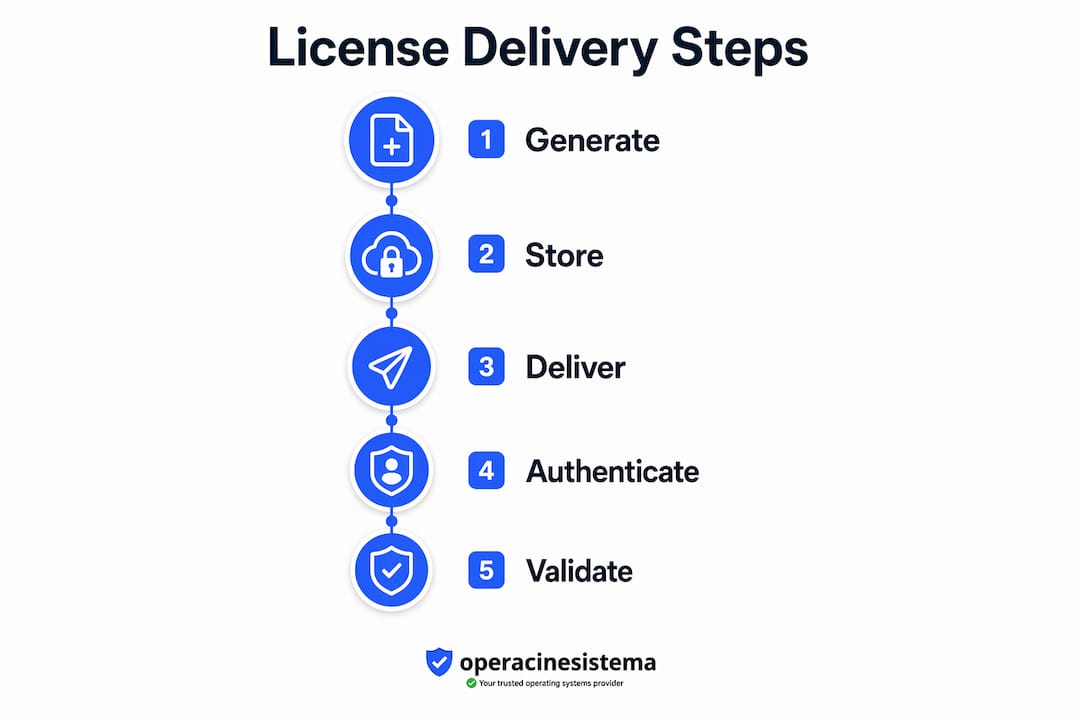
The minimum stack for safe delivery of licenses includes three components. First, a cryptographically secure random number generator for key creation. Second, encrypted storage using AES-256 for keys at rest. Third, an automated delivery platform that sends keys exclusively over HTTPS or through a secure order confirmation page.
| Delivery method | Error rate | Hız | Ölçeklenebilirlik |
|---|---|---|---|
| Manual email delivery | Yüksek | Slow (minutes to hours) | Poor |
| Automated platform (HTTPS) | Çok düşük | Instant (seconds) | Excellent |
| Static download URL | Orta | Hızlı | Poor (easily shared) |
The table above shows why manual delivery fails at scale. Human error, delays, and static URLs that get shared are the three most common failure points in licensing delivery solutions that were not designed with automation in mind.
User authentication is non-negotiable before any license is accessed. Tokenized, expiring download links replace static URLs and prevent unauthorized sharing. A tokenized link is a one-time URL that expires after a set period, typically 15–60 minutes, so even if someone intercepts it, it is already dead.
Profesyonel ipucu: Integrate a license management API instead of building a custom delivery system from scratch. Purpose-built APIs handle key generation, delivery, validation, and revocation out of the box, and they are maintained by teams whose only job is keeping that system secure.
Automated instant delivery reduces errors, delays, and manual processing overhead for merchants. That efficiency gain directly translates to fewer support tickets and happier customers.
How do you generate, store, and deliver licenses securely?
Key generation is where most systems either get it right or introduce a permanent vulnerability. Use a cryptographically random generator that produces keys with at least 128 bits of entropy. That level of randomness makes brute-force guessing computationally impractical.
Generating keys the right way
Never ship your key generator inside the software binary. If you do, a reverse engineer can extract the algorithm and generate unlimited valid keys. Validation logic must run server-side. Client-side checks can be patched out in minutes by anyone with basic debugging skills.
Storing keys without exposing them
Store only the SHA-256 hash of each license key, never the plaintext. Storing only one-way hashes means that even if your database is breached, attackers get a list of hashes they cannot reverse into working keys. Treat license keys exactly like passwords. You would never store a password in plaintext, and the same rule applies here.
Delivering keys after payment
Deliver the license key immediately after payment confirmation. The delivery channel must be HTTPS or a secure order page. Never send keys over unencrypted email as the sole delivery method. Email can be intercepted, forwarded, or stored in insecure inboxes for years.
| Key generation method | Entropy level | Recommended use |
|---|---|---|
| UUID v4 | ~122 bits | Low-risk, short-term licenses |
| CSPRNG hex string (32 chars) | 128 bits | Standard SaaS licenses |
| CSPRNG hex string (64 chars) | 256 bits | High-value enterprise licenses |
| Sequential numeric keys | Near zero | Never use |
For validation speed, implement rate-limiting and caching strategies that keep response times under 10ms for cached results. A 95%+ cache hit rate is the target for production systems. Slow validation frustrates users and signals a poorly built system.
How do you prevent unauthorized access and license sharing?
Layered security is the only reliable approach. A single lock on the front door is not enough when there are ten other ways in.
The core layers for ensuring license security are:
- ✅ Secure login gate: Require user authentication before any license is displayed or downloaded. No anonymous access.
- ✅ Expiring tokenized links: Generate a unique, time-limited URL for each download request. Temporary signed links prevent unauthorized sharing because the link dies after use.
- ✅ AES-256 encryption at rest: All stored license data must use AES-256. This is the current industry standard for data at rest.
- ✅ Server-side validation only: Never trust the client. All activation checks run on your server.
- ✅ License revocation with soft-fail periods: When a license needs to be revoked (payment dispute, fraud, policy violation), do not cut access instantly. A soft-fail period of about 7 days gives legitimate customers time to resolve issues before hard blocking occurs.
- ✅ Offline validation tokens: Use cryptographically signed tokens such as JWT or PASETO for environments with limited connectivity. Offline validation tokens allow secure use without exposing secrets on the client device.
What to avoid: Static download URLs, plaintext key storage, client-side-only validation, and licenses with no expiration or revocation mechanism.
Profesyonel ipucu: Monitor your validation endpoints with rate limiting set at 100 requests per minute per license key and 1,000 requests per minute per IP address. Return HTTP 429 with a Retry-After header and exponential backoff. This stops brute-force attacks before they cause damage.
What are the steps for secure license transfer and compliance tracking?
License transfer is where compliance requirements become most visible. A transfer is not just moving a key from one device to another. It is a legal and technical event that must be documented.
Follow these steps for a secure license transfer that meets enterprise compliance standards:
-
Document the business justification. Before any transfer begins, record why the transfer is needed. Enterprise license transfers require multi-step validation with legal and business partner approvals. This step protects both parties.
-
Obtain legal approvals when required. Device-only transfers (moving a license from one machine to another within the same legal entity) may proceed without legal sign-off. Transfers between different legal entities always require formal approval. Skipping this step creates compliance gaps that surface during audits.
-
Generate a unique transaction ID. Every transfer event must have a unique identifier logged in your system. This ID ties together the source account, destination account, license key hash, timestamp, and approving authority. Without it, you cannot trace what happened if a dispute arises.
-
Execute the transfer through an encrypted channel. Never transfer license credentials over unencrypted connections. Use HTTPS for all transfer API calls and confirm delivery with a signed receipt.
-
Update the audit trail immediately. Log the completed transfer in your license management system within seconds of confirmation. Delayed logging creates gaps that look like tampering during compliance reviews.
-
Notify all affected parties. Send confirmation to both the source and destination accounts. Include the transaction ID, the license details, and the effective date.
-
Enable self-service transfer portals where possible. Self-service license portals allow users to activate, deactivate, and transfer licenses without contacting support. This reduces support costs and improves satisfaction.
Common mistakes to avoid in license transfer workflows
The most frequent error is treating a device-only transfer the same as a legal entity transfer. They have different approval requirements, and mixing them up creates compliance failures. The second most common mistake is failing to revoke the source license after transfer. If the source key remains active, you now have two active licenses from one purchase. That is a licensing violation, and it is auditable. Always confirm deactivation on the source side before activating on the destination.
Licensing best practices for compliance require that every transfer event be reversible and traceable. If you cannot reverse a transfer and restore the original state, your system is not compliant.
Önemli Çıkarımlar
Secure license delivery requires automated, encrypted systems with layered authentication, server-side validation, and full audit trails to protect both the vendor and the customer.
| Nokta | Detaylar |
|---|---|
| Use 128+ bits entropy | Generate keys with a CSPRNG to make brute-force attacks computationally impractical. |
| Store only SHA-256 hashes | Never store plaintext keys; a breached database exposes nothing if only hashes are stored. |
| Automate delivery post-payment | Instant encrypted delivery reduces errors, delays, and support overhead significantly. |
| Layer your security controls | Combine authentication, expiring tokenized links, rate limiting, and revocation workflows. |
| Log every transfer event | Unique transaction IDs and audit trails are required for compliance and dispute resolution. |
What I’ve learned about license security that most guides skip
Building a key generator is the easy part. The real complexity lives in everything that comes after: domain binding, offline validation, analytics, abuse detection, and brute-force protection. Most teams underestimate this until they are already dealing with a breach or a wave of fraudulent activations.
The insight that changed how I think about license systems is this: assume your secrets will leak. Not might leak. Will leak. A customer will share a key. An employee will paste one into a Slack message. A database backup will end up in the wrong place. The system you build must survive that reality. Key rotation and lifecycle management are not optional features you add later. They are the foundation.
I have seen teams spend months building custom license delivery systems, only to discover that domain binding, offline validation, and rate limiting each require their own specialized logic. The better path is almost always to integrate a purpose-built license management API and spend your engineering time on your actual product. The security benefits of purpose-built tools are not marginal. They are structural.
One more thing: automation is not just a convenience. At scale, manual license delivery creates a support burden that grows linearly with your customer base. Automated delivery with self-service portals keeps that burden flat. Your customers get their licenses in seconds, and your team handles exceptions instead of routine deliveries.
— Jewels by ARES
Jewels by ARES and the standard of secure delivery
At Jewels by ARES, we apply the same standard of care to delivering our products that this guide recommends for license delivery: every order is tracked, confirmed, and packaged with precision. We believe that what you receive should match exactly what you chose, with no surprises and no shortcuts.

Our diamond string bracelets are crafted with the same attention to detail that defines a well-built license system: every element is intentional, every material is verified, and every piece ships with the confidence of a brand that stands behind its work. If you value that kind of reliability in the products you wear, you will find it in every Jewels by ARES collection. Browse the full range and find the piece that tells your story.
SSS
What is secure license delivery?
Secure license delivery is the automated process of generating cryptographically random license keys, storing only their hashes, and transmitting them to verified customers over encrypted channels immediately after payment confirmation.
How do I deliver licenses safely without manual errors?
Automate delivery through a platform that sends keys over HTTPS or a secure order page immediately after payment. Automated instant delivery eliminates the delays and errors that come with manual processing.
What encryption standard should I use for license storage?
Use AES-256 for data at rest and store only SHA-256 hashes of license keys, never plaintext. This means a database breach exposes no usable keys.
How does license transfer compliance work in enterprise environments?
Enterprise license transfers require documented business justification, legal approvals for cross-entity transfers, unique transaction IDs, and immediate audit trail updates. Device-only transfers within the same legal entity follow a simpler process without formal legal sign-off.
What is a soft-fail period in license revocation?
A soft-fail period is a grace window, typically around 7 days, during which a flagged license continues to function while the issue is investigated. This prevents legitimate customers from losing access due to payment disputes or processing errors before the situation is resolved.