What Is Software Entitlement? A Clear Business Guide
TL;DR:
- Software entitlement grants explicit, enforceable rights based on purchase agreements and is managed through automated systems. Proper management reduces compliance risks, prevents overspending, and enables accurate renewal negotiations. Failure to manage entitlements exposes organizations to audit penalties and security vulnerabilities.
Software entitlement is defined as the specific, explicit rights granted to a user, device, or organization to access and use defined software products, features, or services based on a purchase agreement. These rights are not informal. They are formalized through contracts, licenses, or subscriptions, then enforced technically by entitlement management systems that control exactly what you can open, run, or configure inside a product. Understanding software entitlement matters because the gap between what you paid for and what you actually have access to is where compliance failures, audit surprises, and wasted spend live. Whether you manage a single software subscription or an enterprise portfolio, knowing how entitlements work protects your budget and your legal standing.
What is software entitlement and how does it work?
A software entitlement is the formal record of what a user or organization is permitted to do inside a software product. It answers four questions: who can use it, what features they can access, how many users or devices are covered, and for how long. Every entitlement traces back to a purchase event, a subscription tier, or a contractual agreement.

Entitlements are not passive records. They are active controls. When you buy a software product, an entitlement is issued and stored in an entitlement management system. That system reads the entitlement record and grants or blocks access in real time. If your subscription lapses, the system revokes access automatically. If you upgrade your plan, new features unlock without manual intervention.
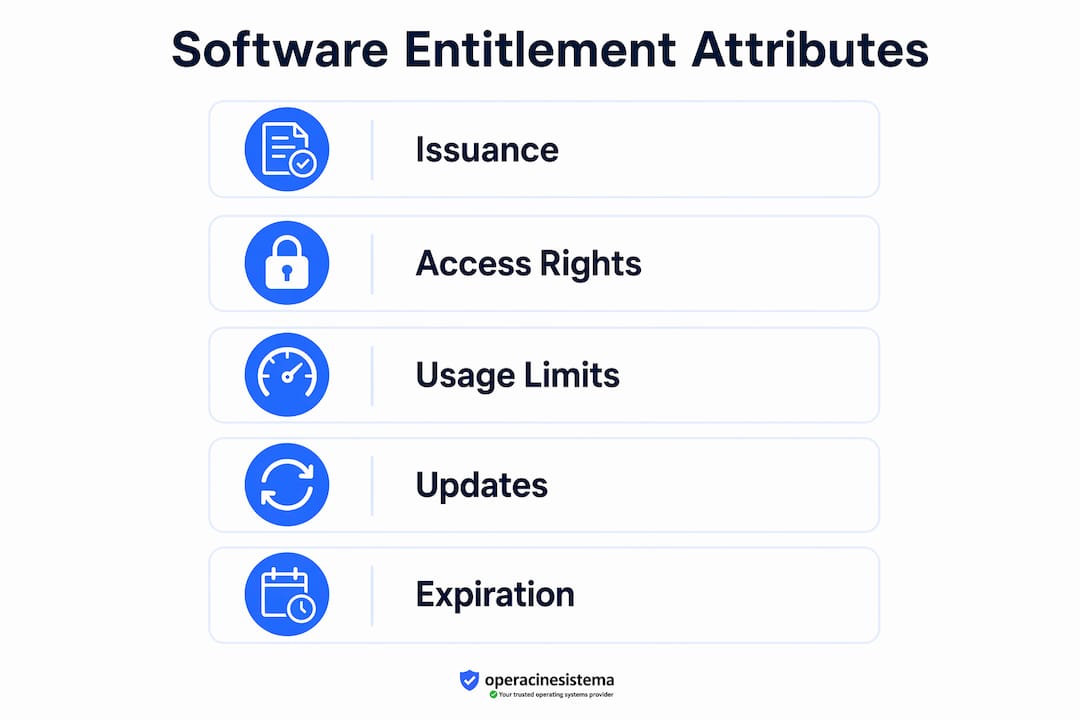
The lifecycle of an entitlement follows a predictable path: issuance at purchase, updates when plans change, and expiration or revocation when the agreement ends. This lifecycle is what makes entitlements different from a simple username and password. Credentials verify identity. Entitlements verify rights.
Key attributes every entitlement contains
Software entitlements specify exactly what actions a user or organization can perform within software. The core attributes include:
- Feature access: Which modules, tools, or capabilities are unlocked
- User or device count: How many seats or endpoints the entitlement covers
- Usage limits: Caps on API calls, data volume, or transaction counts
- Duration: Start and end dates, or perpetual status
- Deployment scope: Whether the entitlement applies to cloud, on-premise, or hybrid environments
Proffstips: Always request a written entitlement summary from your vendor at the time of purchase. This document becomes your reference point during audits and renewal negotiations.
| Attribute | What it controls |
|---|---|
| Åtkomst till funktioner | Which product modules or tiers are available |
| User count | Maximum number of named or concurrent users |
| Device count | Number of machines or endpoints authorized |
| Varaktighet | Active period, renewal date, or perpetual status |
| Deployment type | Cloud, on-premise, or hybrid environment scope |
How do software entitlements differ from licenses and feature flags?
Software licenses are legal agreements defining usage rights, while software entitlements are technical enforcement mechanisms that manage specific access permissions within the software. This distinction matters because confusing the two leads to real compliance problems.
A software license is the legal contract. It defines what you are permitted to do under copyright law. It lives in a PDF or a signed agreement. A software entitlement is the operational implementation of that contract. It lives inside a system that reads your purchase record and decides what the software shows you when you log in. The license says you have rights. The entitlement enforces them.
Licenses vs. entitlements vs. feature flags
| Concept | Who manages it | Primary function | Enforcement method |
|---|---|---|---|
| Software license | Legal and procurement teams | Defines legal usage rights | Contract and audit |
| Software entitlement | Sales and customer success teams | Controls access to purchased features | Entitlement management system |
| Feature flag | Engineering teams | Manages gradual feature rollout | Code-level toggle |
Feature flags are engineering tools used for gradual rollout of features, whereas entitlements are commercial controls managed by sales and customer success teams to enforce purchased rights. This is a critical separation. A feature flag might turn on a new dashboard for 10% of users during a beta test. An entitlement determines whether a paying customer’s account tier includes that dashboard at all.
The practical confusion between these three concepts causes real damage. A business might assume that because a feature is technically visible (a flag is on), they have the right to use it (an entitlement). That assumption fails audits. Conversely, a legal team might believe a signed license is sufficient proof of compliance, without realizing the entitlement system has the wrong user count configured. Both the legal layer and the technical layer must align.
Förståelse software licensing explained as a two-part system, legal rights plus technical enforcement, is the foundation of real compliance.
Why does managing software entitlements matter for compliance?
60% of organizations fail to properly understand which specific product use rights apply during software upgrades, frequently leading to compliance gaps and financial liabilities. That number reflects a systemic problem. Most businesses treat entitlements as an IT detail rather than a business risk.
The consequences of poor entitlement management are concrete:
- Audit exposure: Vendors audit customers to verify that actual usage matches purchased entitlements. Gaps result in back-billing, penalties, or forced license purchases at full price.
- Overspending: Organizations that do not track active entitlements often pay for seats or features no one uses. This waste compounds across multi-year contracts.
- Security gaps: Inactive accounts with active entitlements create unauthorized access risks. Former employees or contractors may retain access long after their departure.
- Upgrade confusion: Software license agreements are detailed technical specifications that govern compliance, not just legal contracts. Misunderstanding this during upgrades leads to audit risks.
- Virtualization errors: Deploying licensed software in virtualized environments without proper monitoring often generates false deployment measurements, resulting in unexpected compliance costs.
“Software entitlements should be seen as strategic business assets that, when governed properly, reduce audit anxiety and enhance business value. Organizations that treat entitlements as operational overhead rather than revenue-critical controls consistently face higher audit costs and lower customer satisfaction scores.”
Proffstips: Perform a full entitlement audit before any major software upgrade or cloud migration. Catching mismatches before the vendor does saves significant money and negotiating leverage.
Failing to properly manage software entitlements frequently leads to compliance violations and security risks. Organizations should perform at least annual verification of user entitlements to remain compliant. Annual is the minimum. Quarterly reviews are better for organizations with high staff turnover or frequent subscription changes.
Entitlements also carry positive business value when managed well. Accurate entitlement records let you negotiate renewals from a position of knowledge. You know exactly what you use, what you do not, and what you need. That clarity translates directly into better contract terms. For more on building that foundation, a software license checklist gives businesses a practical starting point.
How do entitlement management systems work?
Effective entitlement management acts as the operational bridge between a purchase contract and the software product itself, ensuring that access rights are enforced automatically and instantly upon payment confirmation. This automation is what separates modern entitlement management from spreadsheet-based tracking.
An entitlement management system performs three core functions: defining what each customer is entitled to, delivering those entitlements to the correct users or devices, and enforcing the rules in real time. When a customer upgrades their subscription, the system updates their entitlement record and unlocks new features without requiring a support ticket or manual configuration.
Software entitlement management systems enable automation of access control based on licenses, subscriptions, policies, or contracts to protect revenue and reduce manual work. The key capabilities these systems provide include:
- Real-time access control: Grant or revoke access the moment a subscription status changes
- Compliance reporting: Generate audit-ready reports showing who has access to what and when
- Multi-model support: Handle seat licenses, usage-based billing, and feature tier models within one system
- Cross-environment enforcement: Apply consistent rules across SaaS, on-premise, and hybrid deployments
- Automated delivery: Push entitlements to users without manual provisioning steps
The primary goal of entitlement delivery is to make user access invisible, with instant, reliable, and automatic activation across every deployment environment. When entitlement delivery works correctly, users never notice it. They log in, and their purchased features are simply there.
| Deployment model | Entitlement challenge | System response |
|---|---|---|
| SaaS | Subscription tier changes frequently | Automated real-time updates to feature access |
| On-premise | Physical install tracking is complex | License key validation and device-count enforcement |
| Hybrid | Inconsistent enforcement across environments | Unified policy engine covering all endpoints |
Förståelse how software licensing models interact with entitlement systems helps businesses choose the right architecture for their product or procurement strategy.
How can businesses optimize their software entitlement strategies?
Strong entitlement management does not happen by accident. It requires deliberate processes, the right tools, and cross-team alignment. Here are the steps that produce consistent results:
- Conduct a baseline entitlement audit. Map every software product your organization uses against its current entitlement records. Identify gaps between what is licensed and what is deployed. This single step often reveals both over-licensing and under-licensing simultaneously.
- Integrate entitlement management with your Software Asset Management (SAM) program. SAM tracks software assets across the organization. Connecting it to entitlement data gives you a single source of truth for compliance reporting and renewal planning.
- Align sales, product, and customer success teams. Entitlement mismatches often happen because sales promises features that the entitlement system has not been configured to deliver. A shared entitlement definition prevents that gap.
- Replace manual tracking with an automated platform. Manual tracking of entitlements is a security and compliance risk. Spreadsheets do not update in real time, do not flag expired entitlements, and do not generate audit reports. Automated systems do all three.
- Build a process for subscription transitions and upgrades. Every plan change is an entitlement event. Define a workflow that triggers an entitlement update the moment a purchase or cancellation is confirmed.
Proffstips: When managing entitlements across virtualized environments, require your vendor to specify exactly how their license counts virtual machines. Ambiguity here is the most common source of surprise audit bills.
Software reinstallation rights and upgrade scenarios are two of the most frequently misunderstood entitlement situations. Documenting your rights in both cases before you need them prevents costly disputes. For businesses building a compliance program from scratch, software licensing best practices provide a structured framework that covers entitlement governance alongside broader license management.
Viktiga slutsatser
Software entitlement is the technical enforcement of purchased rights, and managing it correctly is the difference between audit confidence and audit liability.
| Punkt | Detaljer |
|---|---|
| Entitlement definition | A software entitlement is the explicit, enforceable right to access specific software features or products based on a purchase agreement. |
| License vs. entitlement | Licenses define legal rights; entitlements enforce those rights technically inside the software system. |
| Compliance risk | 60% of organizations misunderstand their upgrade rights, creating direct exposure to financial penalties and audit failures. |
| Automation is required | Manual entitlement tracking creates security gaps and compliance errors; automated systems enforce rules in real time. |
| Strategic asset value | Accurate entitlement records reduce audit risk, prevent overspending, and strengthen vendor renewal negotiations. |
Why entitlements are the control plane your business cannot ignore
At Jewels by ARES, we work across multiple software platforms to run our operations, from inventory and e-commerce to design tools and customer communications. What I have learned from that experience is that software entitlements are not an IT problem. They are a business control problem.
The shift from perpetual licenses to subscription and usage-based models has made entitlement management more urgent, not less. Every subscription renewal is an entitlement event. Every team member added or removed is an entitlement event. Every product upgrade is an entitlement event. Organizations that treat these as routine IT tickets are the ones that get surprised during vendor audits.
The deeper issue is visibility. Most businesses do not know their full entitlement position at any given moment. They know what they pay for. They do not know what they actually have configured, who is using it, or whether their virtualized deployments are being counted correctly by the vendor’s measurement tools. That gap is where audit liability lives.
My honest view is that entitlement management deserves the same executive attention as financial controls. The financial exposure from a single major software audit can exceed the cost of a proper entitlement management system many times over. Treating entitlements as strategic assets, rather than administrative overhead, is the posture that protects revenue and reduces risk.
The businesses that get this right are the ones that build entitlement reviews into their regular operational calendar, not just their annual compliance checklist. Quarterly reviews, cross-functional ownership, and automated enforcement are not optional extras. They are the baseline for operating safely in a subscription-driven software world.
— Jewels by ARES
Handcrafted bracelets with meaning, made for every occasion
Software entitlements are about rights and value. So is the jewelry you wear. At Jewels by ARES, every bracelet is handcrafted to carry meaning, whether that is the protection symbolism of a red string bracelet or the understated luxury of a diamond string design.
Our diamond string bracelets combine certified diamonds with delicate string settings, creating a piece that works as a personal statement or a gift for someone who deserves something real. Each bracelet ships worldwide in elegant, gift-ready packaging. If you are looking for a piece that carries both beauty and intention, the Jewels by ARES collection is worth your time.
FAQ
What is a software entitlement in simple terms?
A software entitlement is the formal right granted to a user or organization to access specific software features or products based on what they purchased. It is the technical record that tells the software what you are allowed to use.
How is a software entitlement different from a software license?
A software license is a legal agreement defining usage rights, while a software entitlement is the technical mechanism that enforces those rights inside the software. Both must align for an organization to be truly compliant.
Why do software entitlements matter for compliance?
Poor entitlement management leads directly to compliance violations, security risks, and financial penalties during vendor audits. Organizations should verify user entitlements at least annually to stay compliant.
What does an entitlement management system do?
An entitlement management system automates the delivery and enforcement of access rights based on licenses, subscriptions, or contracts. It grants or revokes access in real time when subscription status changes, removing the need for manual provisioning.
What is the biggest risk of not managing software entitlements?
The biggest risk is audit exposure. Deploying software in virtualized environments without proper monitoring frequently generates false deployment measurements, which vendors use to calculate unexpected compliance costs during audits.