What Is Managed Software Delivery: A 2026 IT Guide
TL;DR:
- Managed software delivery involves a provider taking full operational ownership of deployment processes within agreed SLAs, owning outcomes like uptime and incident resolution. It includes managing CI/CD pipelines, infrastructure as code, monitoring, security, and compliance, with clear ownership boundaries defined in contracts; success is measured through DORA metrics, transparency, and automation. The model offers faster deployment, cost predictability, higher reliability, and allows internal teams to focus on product innovation, but requires careful onboarding and avoidance of vendor lock-in through client-controlled infrastructure.
Managed software delivery is defined as an outsourcing model where a provider takes ongoing operational ownership of your software deployment process, managing outcomes within agreed service-level agreements rather than simply supplying staff. Unlike traditional consulting or staff augmentation, the provider owns the results. This model covers CI/CD pipeline management, infrastructure operations, incident response, and continuous improvement. IT managers evaluating this approach need to understand what is managed software delivery before committing to a provider, because the distinction between owning outcomes and renting headcount changes everything about how you structure contracts, measure success, and retain control.
What is managed software delivery and how is it defined?
Managed software delivery is an operational ownership model where a provider takes full responsibility for running and improving a client’s software deployment infrastructure within defined SLAs. The provider does not just advise or staff a project. It owns the service outcomes, including uptime, deployment frequency, incident resolution, and pipeline health.
This model differs sharply from staff augmentation, where contractors join your team and you retain full operational responsibility. It also differs from consulting, where an advisor recommends changes and then leaves. A managed delivery provider stays to operate pipelines and own incidents, becoming a permanent layer of your delivery infrastructure rather than a temporary contributor.
The industry term most closely aligned with this model is “managed DevOps services” or “managed delivery services.” Both phrases describe the same core structure: a provider governs your software delivery lifecycle under a shared responsibility model, with the client retaining product ownership and the provider owning operational continuity.
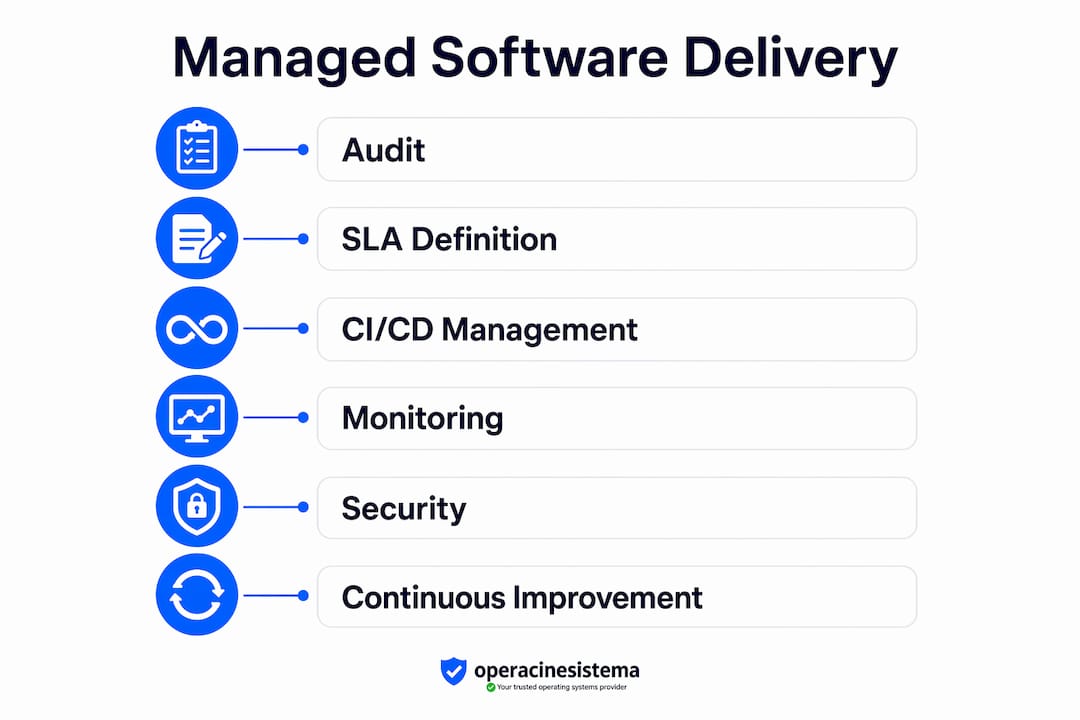
Three foundational elements define every legitimate managed software delivery engagement. First, SLAs set measurable expectations for response times, uptime, and deployment performance. Second, governance frameworks define who owns which decisions and how escalations work. Third, operational reporting, typically through DORA metrics covering deployment frequency, change lead time, and failure rates, gives both parties a shared view of performance.
What components are included in managed software delivery services?
Managed software delivery services cover the full operational stack that sits between your code repository and your production environment. Understanding the scope prevents you from buying a narrow service and assuming it covers everything.
CI/CD pipeline management
The provider owns CI/CD pipeline health end to end. This means fixing broken builds caused by infrastructure drift, updating runners, managing secrets, and tuning caches. Providers use tools like GitHub Actions, Azure DevOps, Jenkins, and Terraform across cloud platforms including AWS, Azure, and GCP. Developers focus on writing code. The provider handles everything that makes that code ship reliably.

Infrastructure as Code and configuration management
Infrastructure as Code, or IaC, is the practice of managing servers, networks, and cloud resources through version-controlled configuration files rather than manual processes. Managed providers use IaC tools like Terraform and Ansible to make infrastructure changes repeatable, auditable, and reversible. This is not optional. IaC is the foundation that makes fast, safe deployments possible at scale.
Monitoring, alerting, and incident management
Full observability is a core deliverable. Providers configure monitoring stacks such as Datadog, Prometheus, CloudWatch, Azure Monitor, and Grafana to give both teams a live view of system health. Monitoring SLAs typically include 24/7 on-call support and defined response times for production issues. When an alert fires at 2:00 AM, the provider responds. Your engineers sleep.
Security integration and compliance automation
Security is embedded into the pipeline rather than bolted on after deployment. Providers integrate static code analysis, dependency scanning, secrets detection, and compliance checks directly into CI/CD workflows. This approach, often called DevSecOps, catches vulnerabilities before they reach production. The secure software delivery practices embedded here are what separate mature managed delivery from basic pipeline hosting.
Shared responsibility model
The client retains ownership of product decisions, feature roadmaps, and business logic. The provider owns operational stability, pipeline performance, and incident resolution. This boundary must be written explicitly into the contract. Ambiguity about who owns what creates friction and delays when incidents occur.
Dica profissional: Ask any prospective provider to show you a live observability dashboard from a current client engagement before signing. If they cannot, that is a signal their transparency model is weaker than their sales pitch.
What are the primary benefits of managed software delivery?
The benefits of managed software delivery are measurable, not theoretical. Organizations that adopt this model report concrete gains across deployment speed, operational cost, and engineering focus.
-
Faster deployment cycles. Modern managed pipelines achieve sub-minute deployments with automated rollbacks. Organizations transitioning from manual processes report moving release cycles from weeks to days or hours. That speed directly reduces the time between a feature being built and a customer using it.
-
Reduced operational firefighting. Up to 75% of DevOps engineers spend significant time on firefighting rather than building. Managed delivery transfers that burden to the provider, freeing your senior engineers for product work. This is one of the most undervalued advantages of managed software solutions.
-
Predictable cost structure. Variable internal overhead, including on-call rotations, tooling licenses, and unplanned incident costs, shifts to a fixed service fee. That predictability makes annual budgeting more accurate and eliminates surprise expenses from production outages.
-
Improved system reliability. Providers operate with defined SLAs for uptime and incident response. Engagements include 15-minute SLAs for production issues and monthly DORA metrics reporting. Reliability becomes a contractual obligation, not an aspiration.
-
Internal engineering focus on product innovation. When operational tasks move to the provider, your engineers stop context-switching between infrastructure problems and feature development. Teams that stop firefighting consistently ship more product value per sprint.
-
Transparency through dashboards and SLAs. Shared observability dashboards and audit logs give your team full visibility into what the provider is doing and how systems are performing. Clients achieve the best outcomes when SLAs, governance, reporting, and escalation frameworks are clearly defined from day one.
Stat callout: Up to 75% of DevOps engineers spend time on firefighting. Managed delivery services are specifically designed to eliminate that bottleneck and redirect engineering capacity toward product work.
How does managed software delivery work in practice?
Understanding how managed software delivery works requires looking at the full engagement lifecycle, from first contact through steady-state operations.
Onboarding and audit phase
Every structured engagement begins with a pipeline and infrastructure audit. The provider reviews your existing CI/CD configuration, branching strategy, deployment targets, and monitoring setup. Providers should gain immediate access to internal code repositories and respect existing branching strategies rather than imposing proprietary workflows. Disrupting established engineering processes during onboarding is one of the fastest ways to destroy team trust.
Defining scope, SLAs, and escalation protocols
The contract defines exactly what the provider owns and what the client retains. SLAs specify response times, uptime targets, and deployment frequency goals. Escalation protocols define who gets called, in what order, and within what timeframe when a production incident occurs. Vague contracts produce vague accountability.
Transparency and observability
Shared dashboards and audit logs are not optional extras. They are the mechanism that prevents “black box” service delivery, where the provider operates invisibly and the client has no insight into what is happening or why. Every action the provider takes should be logged and visible to the client team.
The table below compares two engagement models to clarify where managed delivery sits relative to other options.
| Dimension | Staff augmentation | Managed software delivery |
|---|---|---|
| Who owns outcomes? | Client | Provider |
| Incident response | Client’s internal team | Provider’s on-call team |
| Cost structure | Variable (headcount) | Fixed (service fee) |
| Tooling ownership | Client | Client (via IaC requirements) |
| Reporting cadence | Ad hoc | Monthly DORA metrics |
| Exit flexibility | Alta | Depends on contract terms |
Contractual incentives and continuous improvement
Contracts must include automation goals and continuous improvement metrics. Billing models based on ticket volume risk disincentivizing automation, because a provider paid per ticket has no financial reason to reduce ticket volume. Agreements must tie provider compensation to DORA improvements and automation milestones instead.
Avoiding vendor lock-in
Contracts should require all infrastructure to be managed via IaC tools that the client owns. This means your Terraform files, your Kubernetes manifests, and your pipeline configurations live in your repositories. If you switch providers, you take the infrastructure code with you. Without this clause, a provider transition can require rebuilding your entire delivery stack from scratch.
Dica profissional: Require a “runbook handover” clause in your contract. This forces the provider to maintain documentation sufficient for your team or a new provider to take over operations within 30 days.
What are the common pitfalls in managed software delivery?
Managed software delivery fails in predictable ways. Knowing the failure patterns before you sign a contract is the most practical risk management available.
-
Vendor lock-in through proprietary tooling. Some providers build delivery infrastructure on closed portals or internal platforms that only they can operate. When you try to leave, you have nothing. Require open tooling and client-owned IaC from the start. Open tooling and IaC are the essential safeguards against this outcome.
-
Perverse billing incentives. A provider paid by ticket volume will generate tickets. That is not a conspiracy theory. It is a predictable response to financial incentives. Structure contracts around automation milestones and DORA metric improvements, not activity volume.
-
Hand-off friction and workflow mismatches. Providers who demand you migrate to their preferred branching strategy or deployment tooling before they start work are prioritizing their convenience over your stability. Preserving existing workflows reduces friction and accelerates onboarding success.
-
Erosion of internal engineering culture. Managed delivery works best when it operates live systems, not when it replaces your engineering team’s ability to understand those systems. Keep your senior engineers involved in architecture decisions. Do not let the provider become the only people who understand your infrastructure.
-
Reactive ticketing instead of proactive automation. The defining characteristic of a high-quality managed delivery provider is that they fix problems before you notice them. If your provider’s primary output is incident tickets rather than automated remediation, you are paying for a help desk, not a managed delivery service.
-
Unclear escalation paths. When a production outage occurs at 3:00 AM, ambiguity about who calls whom costs you minutes you cannot afford. Define escalation paths in writing before the engagement starts, and test them during onboarding.
Compreensão why software support matters at the operational level helps IT managers recognize which of these pitfalls are most likely to surface in their specific environment.
Principais conclusões
Managed software delivery succeeds when providers own outcomes, clients retain code and infrastructure assets, and contracts enforce automation incentives through DORA metrics rather than ticket volume.
| Ponto | Detalhes |
|---|---|
| Ownership defines the model | Managed delivery means the provider owns service outcomes, not just labor hours. |
| IaC prevents lock-in | Require client-owned Infrastructure as Code in every contract to protect your exit options. |
| DORA metrics measure success | Track deployment frequency, change lead time, and failure rates monthly to verify provider performance. |
| Transparency is contractual | Shared dashboards and audit logs must be written into the agreement, not assumed. |
| Firefighting costs are real | Up to 75% of DevOps engineer time spent on firefighting is recoverable through managed delivery. |
What I have learned from watching managed delivery engagements succeed and fail
The most common mistake IT managers make is treating managed software delivery as a cost-cutting exercise. It is not. The organizations that get the most value from this model use it to scale operational maturity faster than their internal team could alone.
The client-provider relationship dynamic matters more than the technology stack. I have seen technically excellent providers fail because the client’s engineering team felt sidelined and stopped sharing context. The provider then operated in a vacuum, making decisions without the institutional knowledge needed to make them well. The fix is simple but requires discipline: keep your senior engineers in the loop on architecture decisions, even when the provider owns operations.
The onboarding phase is where most engagements are won or lost. Providers who rush onboarding to hit a billing start date almost always create problems that take months to untangle. Insist on a structured audit before any SLA clock starts. That audit is not overhead. It is the foundation everything else is built on.
One observation that surprises most managers: the best managed delivery providers actively work to reduce their own workload through automation. That sounds counterintuitive until you realize that a provider with well-structured incentives makes more margin on automated systems than on manual incident response. Align the financial incentives correctly, and the provider’s self-interest and your operational goals point in the same direction.
O AI SLA frameworks emerging in 2026 are starting to influence how managed delivery contracts are structured, particularly around observability and automated escalation. IT managers evaluating new engagements should ask prospective providers how they incorporate these frameworks into their SLA definitions.
— Jewels by ARES
Precision matters in every craft, including delivery
At Jewels by ARES, we understand that quality is built through disciplined process, not shortcuts. The same principle applies to software delivery: every step in the chain matters, and ownership of outcomes is what separates a reliable partner from a vendor. Whether you are building systems that ship code or pieces that carry meaning, the craft behind the result is what endures. Explore our handcrafted string bracelets collection, where every piece is made with the same attention to process and outcome that the best managed delivery teams bring to your pipeline. Jewels by ARES ships worldwide in gift-ready packaging, designed for those who value what is made with intention.
Perguntas frequentes
What is managed software delivery in simple terms?
Managed software delivery is a model where an external provider takes full operational ownership of your software deployment process, managing CI/CD pipelines, infrastructure, monitoring, and incidents within agreed SLAs rather than just supplying staff.
How does managed software delivery differ from staff augmentation?
Staff augmentation adds contractors to your team while you retain operational responsibility. Managed delivery transfers outcome ownership to the provider, who is accountable for uptime, deployment performance, and incident resolution.
What are the main benefits of managed software delivery?
The primary benefits include faster deployment cycles, reduced engineering firefighting, predictable costs, improved system reliability, and greater internal focus on product development rather than infrastructure maintenance.
How do I avoid vendor lock-in in a managed delivery contract?
Require all infrastructure to be managed through client-owned Infrastructure as Code tools like Terraform. This means your configuration files stay in your repositories and travel with you if you change providers.
What metrics should I use to measure managed software delivery performance?
DORA metrics are the industry standard: track deployment frequency, change lead time, change failure rate, and mean time to recovery. Monthly reporting against these four indicators gives you an objective view of provider performance.