The Role of Customer Support in Licensing Success
TL;DR:
- Customer support in licensing goes beyond troubleshooting by managing activations, ensuring compliance, and guiding policy changes. Effective support processes prevent license gaps, enable quick issue resolution, and foster renewal loyalty, significantly impacting licensing outcomes. Investing in structured, knowledgeable support teams is vital for maintaining compliance and maximizing software value.
Most business owners think of customer support as a safety net you call when something breaks. In software licensing, that assumption is expensive. The role of customer support in licensing goes far beyond answering tickets. Support teams activate licenses, prevent compliance failures, manage billing transitions, and serve as the operational backbone of your entire licensing lifecycle. If you are acquiring, managing, or renewing software licenses at any scale, understanding how support functions in that process is not optional. It directly affects your compliance standing, your budget, and whether your software keeps working tomorrow.
Inhoudsopgave
- Belangrijkste opmerkingen
- The role of customer support in licensing activation workflows
- Support as a compliance gate and quality control point
- Technology and portal tools in licensing support workflows
- Subscription lifecycle transitions and the support imperative
- How support delivery models shape licensing outcomes
- My honest take on licensing support strategy
- Get your licensing right with Operacinesistema
- FAQ
Belangrijkste opmerkingen
| Punt | Details |
|---|---|
| Support activates entitlements | Support teams generate activation codes and manage license exceptions throughout the customer lifecycle. |
| Compliance depends on support | Proactive support prevents entitlement drift and catches compliance gaps before they become costly violations. |
| Lifecycle transitions create risk | Policy changes like Microsoft’s Extended Service Terms make proactive support contact a compliance requirement. |
| Technology tools amplify support | Centralized portals like Cisco’s CSSM give support teams the visibility they need to guide customers accurately. |
| Support model shapes outcomes | The structure of your support delivery directly influences renewal rates, loyalty, and licensing compliance. |
The role of customer support in licensing activation workflows
You cannot use software you cannot activate. That sounds obvious, but the workflows behind activation are anything but simple, especially in cloud and SaaS environments. Support teams sit at the center of this process, and their ability to execute quickly determines whether your business operates or stalls.
In cloud licensing models, support is often responsible for generating activation codes and sending trial licenses as part of an approval workflow. This is not a passive task. When a customer qualifies for a license exemption, the support team coordinates with account managers, validates the request, and delivers the entitlement. GitLab’s internal handbook makes this explicit: account managers open support requests, and the support team generates and sends the actual activation codes or trial licenses.
Here is what that looks like in practice for a business:
- Request initiation. Your account manager submits an internal support request on your behalf, citing the reason for a licensing exception or custom entitlement.
- Validation and approval. The support team reviews the request, confirms eligibility, and coordinates with sales or finance as needed.
- Code generation. Support generates the appropriate activation or trial code and delivers it directly to the customer contact.
- Confirmation and documentation. The transaction is logged for compliance tracking, creating a record that protects both parties.
Offline licenses and legacy deployments add another layer. These situations require planned support playbooks because the standard automated activation paths do not apply. A customer running air-gapped servers, for example, cannot phone home to a cloud licensing server. Support must coordinate a manual license reservation and delivery process, often requiring approval from multiple internal teams before the customer gets their key.
Pro Tip: Map every activation exception scenario your business might encounter before you sign a licensing agreement. Ask your vendor’s support team directly: “What happens if our environment cannot connect to your cloud licensing server?” The answer tells you a lot about how mature their support workflows actually are.
The customer service impact on licensing is clearest at activation time. A support team that does not have documented exception workflows leaves customers stranded at the worst possible moment: right when they are trying to deploy software they have already paid for.

Support as a compliance gate and quality control point
There is a widespread assumption that compliance is the legal team’s job. In software licensing, the front line of compliance is your support team, not your attorneys. By the time legal gets involved, the violation has usually already happened.
High-quality licensing support roles embed governance and compliance as functional pillars, requiring specialized staffing beyond typical helpdesk capabilities. Accenture’s Licensing Associate Manager role for Microsoft renewals is a useful model here. That position is explicitly responsible for ensuring compliant guidance during renewals, managing escalation paths, and implementing quality controls across licensing workflows. This is not a helpdesk job. It is a governance function dressed in a support title.
What does this compliance gate role look like in practice?
- Renewal audits. Support reviews license counts against actual usage before renewal to prevent over-purchasing or, more commonly, the dangerous under-licensing that triggers audit penalties.
- Escalation management. When a customer’s license situation does not fit standard policy, support escalates through a defined path rather than improvising, reducing the risk of non-compliant workarounds.
- Policy interpretation. Support communicates vendor policy changes to customers in plain language, so business owners understand what they must do before deadlines hit.
- Quality checks. Before a license transaction closes, support validates that the correct product SKU, term length, and user count are in place.
“Support is more than reactive help. It acts as a control point preventing entitlement drift and ensuring adherence to licensing workflows post-sale.” — GitLab Handbook
The importance of support in licensing becomes undeniable when you consider how entitlement drift happens. Over time, organizations add users, change deployment environments, and let trials expire without formal conversion. Without a support team actively managing these transitions, you end up with a licensing gap that only surfaces during an audit. At that point, the cost of fixing it is many times greater than what proactive support would have cost.
Following software licensing best practices requires someone to own the compliance function continuously, not just at renewal time.
Technology and portal tools in licensing support workflows
Tools matter. A support team without proper systems is working blind, and a licensing portal without trained support behind it is just an unused dashboard. The most effective licensing operations combine both.
Cisco’s Smart Licensing system and its Cisco Smart Software Manager (CSSM) portal is one of the clearest examples of how technology and support intersect. CSSM acts as a centralized container holding all of a customer’s Cisco software assets. It supports license pooling, portability across products, and compliance reporting. Critically, it gives support teams real-time visibility into what a customer is entitled to, what they are using, and where gaps exist.
But the portal alone does not solve the problem. Support teams must guide customers through the correct activation method depending on their deployment environment. That is where human judgment is irreplaceable.
| Deployment model | Activeringsmethode | Support’s role |
|---|---|---|
| Direct (cloud-connected) | Automatic via CSSM | Monitor entitlement and verify usage reporting |
| Offline (air-gapped) | Specific license reservation | Obtain manual authorization codes and document approval |
| On-premise with proxy | Smart Call Home or transport gateway | Configure and validate the reporting path |
| Hybrid environments | Mixed methods | Coordinate between teams to cover all product families |
Centralized licensing portals empower support teams to operationalize compliance through visibility and correct authorization workflows. Without that visibility, support is guessing. With it, support can identify a compliance gap in minutes and guide a customer through the resolution before it escalates.
The lesson for business owners is straightforward. When evaluating a software vendor, ask whether their support team has direct access to your entitlement data in a shared portal. If support must request that data from a separate team before they can help you, you have just added hours or days to every support interaction. That delay has real compliance consequences.
Subscription lifecycle transitions and the support imperative
Licensing policies change. Vendors update terms, restructure grace periods, and introduce new billing models. When they do, your support team is either your early warning system or your cleanup crew. The difference between those two roles is enormous.
Microsoft’s introduction of Extended Service Terms (EST) for CSP subscriptions is a current example every business owner should understand. Starting May 4, 2026, EST replaces free grace periods, meaning partners and customers must proactively choose their end-of-term subscription status before deadlines. There are no support exceptions for missed intents. If you miss the window, you pay. Period.
This change has specific implications for how support must operate:
- Proactive subscription audits. Support teams must identify which subscriptions are approaching their end-of-term date and contact the customer before the window closes.
- Intent documentation. Partners must log whether a customer intends to renew, cancel, or modify their subscription, with a clear record of when that decision was communicated.
- Customer education. Many business owners do not know this policy exists. Support’s job is to make sure they do before it costs them money.
- No exception safety net. Under EST, the old practice of calling support after the fact to reverse an unintended charge is gone. Proactive customer engagement is the only protection.
This is exactly the kind of policy change that separates businesses with strong licensing support from those without. If your Microsoft reseller or IT partner has not contacted you about EST yet, that is itself a signal about their support quality.
Pro Tip: Request a formal notification from your licensing partner every time a vendor announces policy changes that affect subscription terms or grace periods. If they cannot commit to that, consider whether they are truly managing your licensing compliance or just processing your renewals.
Understanding how support aids licensing through lifecycle transitions requires recognizing that the shift toward pre-emptive guidance is not optional. Vendors are tightening policies and removing safety nets. The only buffer left is a support team that stays ahead of the calendar.
Knowing how to support end-users through Microsoft OS transitions, for example, is now a core competency, not a nice-to-have.
How support delivery models shape licensing outcomes
Not all support is equal. The structure of how support is delivered, who owns the customer relationship, and how escalations are handled has a measurable effect on licensing compliance, customer satisfaction, and renewal rates.
The traditional model puts an OEM vendor’s support team between your partner and a resolution. A partner calls Microsoft, waits in queue, explains the issue from scratch, and then relays the answer back to you. Every handoff in that chain is a delay. Every delay is a risk.
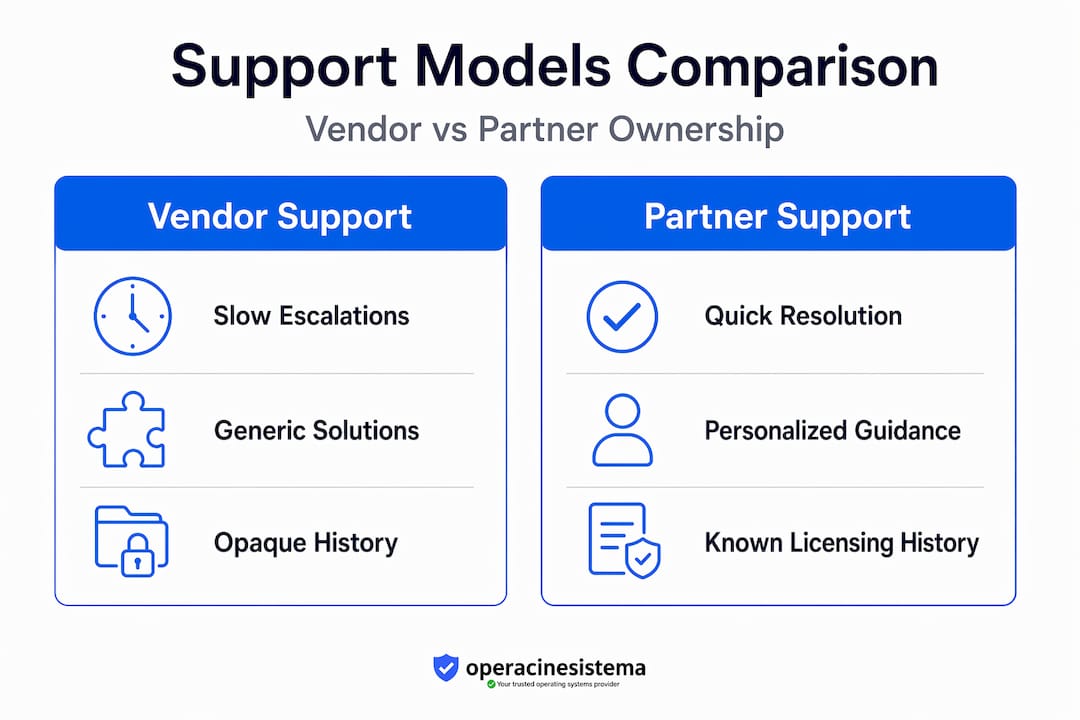
US Cloud’s white-label Microsoft support program represents a different approach. Partners can deliver enterprise-level support under their own brand, with US and EU-based senior engineers handling SLAs and escalations behind the scenes. The customer sees one face. The partner maintains the relationship. The backend expertise is there without the friction of OEM escalation layers.
Why does this matter for licensing specifically?
- Faster activation resolution. When licensing issues arise, a partner-branded support team with direct access to engineering expertise resolves them faster than a multi-tier OEM queue.
- Relationship continuity. The support agent who helps you today already knows your licensing history, your deployment environment, and your renewal timeline.
- Compliance consistency. A stable support relationship means policy changes get communicated proactively, not discovered reactively.
- Renewal loyalty. Customers with positive, consistent support experiences renew at higher rates and are more likely to expand their licensing rather than shop for alternatives.
Designing support as a strategic function influences renewal rates, customer satisfaction, and overall licensing process efficiency. That is not an abstract claim. It is what you see when you compare businesses that treat support as a cost center against those that treat it as a compliance and retention tool.
The licensing customer service best practices here are clear: evaluate your vendor’s or partner’s support structure as seriously as you evaluate the license price itself. A cheaper license with poor support often costs more in the long run.
My honest take on licensing support strategy
I’ve spent years watching businesses sign software contracts and immediately forget that support exists until something goes wrong. That’s the wrong mental model, and it creates completely avoidable problems.
In my experience, the companies that handle licensing well all share one trait: they treat support as an operational partner, not a customer service desk. They have a named contact. They know the escalation path. They ask questions before deadlines, not after. That discipline is rarely natural. It has to be built intentionally.
What I’ve also seen is that most licensing compliance failures are not caused by bad faith or ignorance of the rules. They are caused by communication gaps between the vendor, the support team, and the customer. A license expires because nobody sent a renewal notice. A billing error occurs because nobody audited the subscription settings before the grace period ended. These are support process failures, not technical ones.
My take on improving customer support for licensing is this: structure matters more than headcount. One support specialist with clear workflows, access to entitlement data, and defined escalation paths will outperform a large team with no documentation and no ownership. If you are evaluating a licensing partner, ask them to walk you through their exception workflow for a missed renewal. If they hesitate, you have your answer.
The complexity of modern licensing, from cloud subscriptions to hybrid deployments, is only increasing. The role of support teams in licensing will grow with that complexity. Investing in that function now, whether internally or through a qualified partner, is the most practical compliance decision you can make.
— Danielius
Get your licensing right with Operacinesistema
If reading this has made you think harder about your licensing situation, that is a good thing. The next step is making sure the licenses you hold are genuine, properly activated, and supported from day one.
At Operacinesistema, every Windows license comes with clear activation support so you never get stuck at the point where it matters most. Whether you need to understand Windows license types like OEM, Retail, or Volume, or you are ready to purchase a genuine license key with instant delivery and full activation guidance, the process is straightforward. If you want a structured overview before buying, the software license checklist for 2026 walks you through every compliance consideration for small and medium businesses. Genuine software, clear support, and no compliance surprises. That is the standard you should expect.
FAQ
What is the role of customer support in licensing?
Customer support in licensing manages activation workflows, handles compliance exceptions, guides customers through policy changes, and acts as a quality control point throughout the license lifecycle. It is both an operational and a compliance function.
How does support prevent licensing compliance failures?
Support teams prevent compliance failures by auditing entitlements, catching usage gaps before renewals, communicating policy changes proactively, and maintaining documented escalation paths so exceptions are handled correctly rather than improvised.
Why does the support delivery model affect licensing outcomes?
The structure of support delivery determines how quickly issues are resolved, whether your licensing history is known to the person helping you, and how consistently compliance guidance reaches you. Better support structures produce higher renewal rates and fewer compliance incidents.
What is Microsoft’s Extended Service Term and why does support matter?
Microsoft’s Extended Service Term replaces free grace periods for CSP subscriptions starting May 4, 2026, requiring partners and customers to declare end-of-term intent before deadlines with no support exceptions for late action. Proactive support contact is the only way to avoid unintended charges.
How do I know if a licensing partner has strong support?
Ask them to describe their workflow for a missed renewal or activation exception. A strong partner will walk you through a documented process with named escalation steps. Hesitation or vague answers indicate the absence of the governance structures that protect your compliance.