Secure Software Delivery Explained for Developers in 2026
TL;DR:
- Secure software delivery embeds security controls throughout the software lifecycle using frameworks like NIST SSDF, ISO/IEC 27034, and SLSA.
- Modern CI/CD pipelines automate security with techniques such as Security-as-Code, signed SBOMs, ephemeral build agents, and strict artifact verification.
Secure software delivery is defined as the practice of embedding security controls into every stage of the software lifecycle, from the first line of code through production deployment, to protect integrity, confidentiality, and reliability. The industry term for this practice is the Secure Software Development Lifecycle, or SSDLC. As software supply chain attacks grow more frequent, understanding what is secure software delivery is no longer optional for developers and IT teams. Frameworks like NIST SP 800-218 (SSDF), SLSA provenance standards, and Software Bill of Materials (SBOM) verification now define the baseline for any team serious about secure software deployment. This article breaks down the frameworks, pipeline techniques, and real-world practices you need to get it right.
What frameworks and standards define secure software delivery?
The NIST Secure Software Development Framework, published as NIST SP 800-218, organizes secure software delivery into four practice groups: preparing the organization, protecting the software, producing well-secured software, and responding to vulnerabilities. Each group addresses a distinct phase of the delivery lifecycle. Together, they form the most widely adopted government-backed standard for software security in the United States.
The SSDLC extends the traditional Software Development Lifecycle by weaving security requirements, threat modeling, and verification into phases that previously focused only on functionality. A team following SSDLC does not bolt security on at the end. Security gates appear at design, coding, testing, and deployment stages. That shift alone eliminates entire categories of late-stage vulnerabilities that are expensive to fix.
Two additional standards shape organizational norms beyond NIST. ISO/IEC 27034 provides a framework for application security controls at the organizational level, defining how security requirements map to software controls. OWASP SAMM (Software Assurance Maturity Model) gives teams a measurable maturity model to assess and improve their security practices over time. Both are widely referenced in compliance audits and vendor assessments.
Regulatory adoption is accelerating. U.S. federal agencies now require SSDF alignment for software vendors under Executive Order 14028. The European Union’s Cyber Resilience Act similarly mandates security-by-design principles for software sold in EU markets. Compliance is no longer a checkbox. It is a market access requirement.
Key frameworks at a glance
| Framework | Scope | Primary use |
|---|---|---|
| NIST SP 800-218 (SSDF) | Full delivery lifecycle | U.S. federal compliance and vendor requirements |
| ISO/IEC 27034 | Organizational application security | Enterprise security control mapping |
| OWASP SAMM | Maturity assessment | Team-level security improvement roadmap |
| SLSA (Supply chain Levels for Software Artifacts) | Artifact provenance | Build integrity and supply chain verification |
- SSDF defines what your organization must do at each delivery stage.
- ISO/IEC 27034 defines how security controls map to application requirements.
- OWASP SAMM measures how mature your current practices are.
- SLSA verifies that your build artifacts are what they claim to be.
How do modern CI/CD pipelines implement secure software delivery in 2026?
Securing a CI/CD pipeline in 2026 means treating security as code, not as a manual review step. The practical techniques have matured significantly, and the gap between teams that automate security gates and those that do not is now measurable in breach frequency.
1. Shift security left with Security-as-Code
Security-as-Code means writing security policies in versioned, machine-readable files that live alongside your application code. Tools like OPA/Gatekeeper or Kyverno enforce these policies automatically at build, deploy, and runtime stages. A policy file can block any container image that lacks a verified signature or runs as root. The pipeline rejects the deployment before it reaches production. No human review needed.

2. Generate and verify SBOMs at every build
A Software Bill of Materials (SBOM) is a machine-readable inventory of every component in your software. Signed provenance at SLSA Level 3 links each artifact to its source commit and build identity, making supply chain tampering detectable. When a new vulnerability like Log4Shell appears, a team with current SBOMs can identify affected services in minutes rather than days. Teams without SBOMs are guessing.
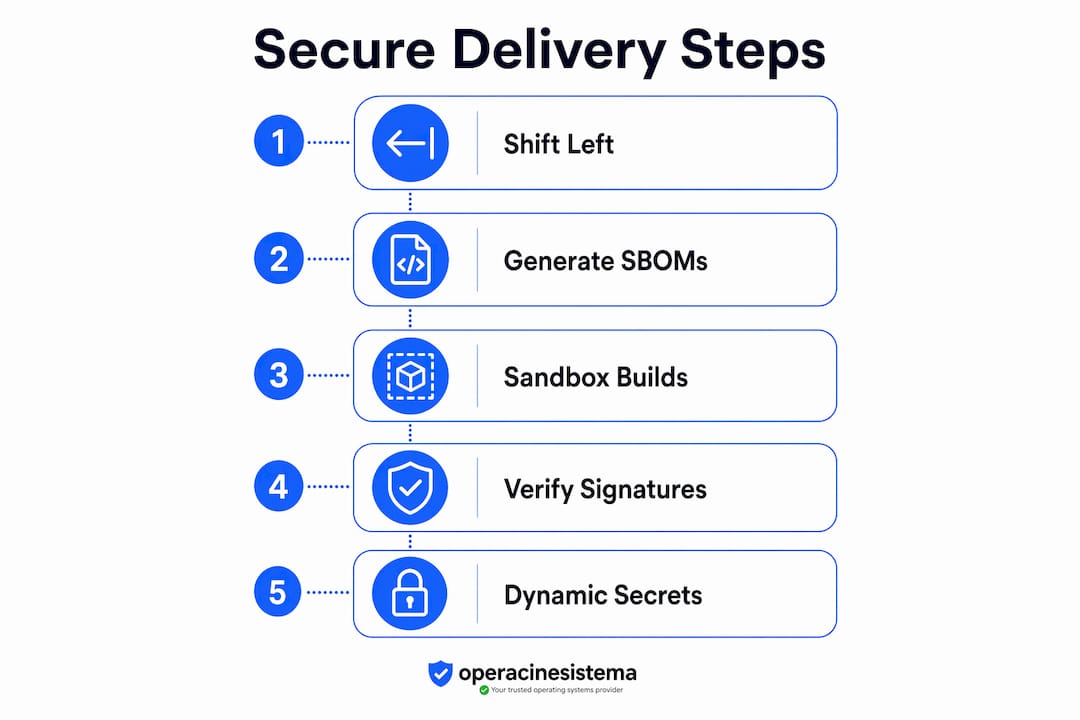
3. Use ephemeral, sandboxed build agents
Long-lived build servers create persistent attack surfaces. An attacker who compromises a shared build agent can inject malicious code into every subsequent build that runs on that machine. Ephemeral agents spin up fresh for each job and are destroyed immediately after. There is no persistent state for an attacker to exploit between jobs.
4. Enforce strict artifact signature verification
Signing artifacts is only half the job. Deployment systems must reject unsigned or unverifiable artifacts automatically. A signature that no gate checks provides no real protection. Configure your deployment system to fail closed: if verification cannot be confirmed, the deployment does not proceed.
5. Inject secrets dynamically at runtime
Secrets stored in git history or config files are compromised the moment the repository is accessed by an unauthorized party. Use a secrets vault like HashiCorp Vault or AWS Secrets Manager to inject credentials at runtime only. Treat any secret that has touched a repository as already breached and rotate it immediately.
Profesionāļu padoms: Run a git history scan with a tool like truffleHog or gitleaks before onboarding any legacy repository into a new pipeline. Secrets buried in old commits are a common and overlooked attack vector.
What advanced security concepts enhance software delivery security?
Basic pipeline controls stop known attack patterns. Advanced security concepts address the harder problems: insider threats, alert overload, and the growing complexity of cloud-native supply chains.
Zero Trust in CI/CD environments
Zero Trust architecture means no pipeline actor is trusted by default, regardless of network location or role assignment. Many teams rely solely on RBAC, which controls what a user can do but does not validate whether the pipeline runner itself has been compromised. Zero Trust requires CI/CD runners to be validated by external security services before they execute. If a runner’s identity cannot be confirmed, it does not run. This approach stops credential compromise attacks that RBAC alone cannot catch.
Profesionāļu padoms: Treat your CI/CD pipeline as an untrusted external system, not a trusted internal one. Apply the same identity verification you would to a third-party API call.
Application Security Posture Management (ASPM)
Alert fatigue is a real and documented failure mode. Siloed scanners generate thousands of findings, and teams stop acting on them because they cannot separate critical risks from theoretical ones. ASPM aggregates and de-duplicates findings based on cloud context, focusing attention on vulnerabilities that are both reachable and exploitable in your specific environment. The result is a shorter, more accurate list of issues that actually need fixing. Teams using ASPM spend less time triaging and more time remediating.
Secrets management beyond environment variables
- Store all secrets in a dedicated vault, never in environment variables baked into container images.
- Use short-lived, auto-rotating credentials wherever the target service supports them.
- Audit vault access logs regularly to detect unusual access patterns before they become incidents.
- Scope secrets to the minimum required permission. A build agent that only needs to push to one registry should not have write access to your entire artifact store.
Multi-party approval workflows
High-risk deployments, such as production releases or infrastructure changes, benefit from multi-party approval gates. Two engineers must approve before the pipeline proceeds. This control balances delivery velocity with accountability. It also creates an audit trail that satisfies compliance requirements under frameworks like SOC 2 and ISO 27001.
How to apply software delivery security best practices in real deployments?
Knowing the frameworks is one thing. Putting them into practice in a real team environment requires deliberate process design. Cloud providers secure the underlying infrastructure, but pipeline security configuration is always the team’s responsibility. That boundary is where most real-world breaches occur.
Here is a practical checklist for developers and IT teams:
- ✅ Integrate vulnerability scanning into developer workflows. Run static analysis and dependency checks on every pull request, not just in nightly batch jobs. Developers fix issues faster when feedback arrives in their existing tools.
- ✅ Automate policy enforcement in pipelines. Write security policies as code and enforce them at every pipeline stage. Manual approval gates are too slow and too inconsistent for modern delivery cadences.
- ✅ Sign every artifact cryptographically. Use Sigstore’s Cosign or a comparable tool to sign container images and binaries at build time. Configure deployment gates to reject anything unsigned.
- ✅ Maintain current SBOMs for every production service. Update SBOMs on every build. Store them in a queryable format so you can respond to new CVEs within hours, not weeks. Learn more about software validation in compliance contexts to understand how this ties to licensing requirements.
- ✅ Train your team on secure coding standards. Technical controls fail when developers do not understand why they exist. Regular training on OWASP Top 10 and supply chain attack patterns builds the cultural foundation that makes every other control more effective.
- ✅ Review your security best practices annually. The threat landscape shifts every year. A control that was sufficient in 2024 may be inadequate in 2026.
The teams that execute these steps consistently outperform those that treat security as a project rather than a process. Security debt compounds just like technical debt. The earlier you address it in the delivery cycle, the cheaper it is to fix.
Galvenie secinājumi
Secure software delivery requires embedding verified, automated security controls at every pipeline stage, from code commit through production deployment, with no exceptions.
| Punkts | Sīkāka informācija |
|---|---|
| NIST SSDF is the baseline | Align your delivery process to the four SSDF practice groups for compliance and security coverage. |
| SBOMs and SLSA provenance are non-negotiable | Generate signed SBOMs at every build to enable rapid vulnerability response and supply chain verification. |
| Ephemeral build agents reduce risk | Destroy build agents after each job to eliminate persistent attack surfaces in your pipeline. |
| Zero Trust replaces RBAC alone | Validate every pipeline actor with external identity verification, not just role-based access controls. |
| ASPM cuts alert fatigue | Use Application Security Posture Management to focus remediation on reachable, exploitable vulnerabilities. |
The uncomfortable truth about pipeline security in 2026
At Jewels by ARES, we work with craftsmanship and trust every day. That experience has given us a clear view of what “secure delivery” actually means in practice, and it is not what most teams think.
The most common mistake I see is treating pipeline security as an infrastructure problem. Teams spend months hardening their Kubernetes clusters and then leave their build agents running as long-lived, shared machines with broad permissions. The cluster is locked down. The pipeline is wide open. Attackers know this. Supply chain attacks target the build process precisely because it sits upstream of every security control you apply to the running application.
The second mistake is confusing compliance with security. Passing an SSDF audit means you have documented controls. It does not mean those controls are working. I have seen teams with perfect audit scores and hardcoded secrets in their git history. Documentation and reality diverge fast when no one is running continuous verification.
The trend I find most promising in 2026 is AI-assisted security posture management. Early tools can now correlate findings across scanners, rank them by actual exploitability in your specific environment, and suggest remediation steps. That is a genuine productivity multiplier for small security teams. But AI tools are only as good as the data they ingest. If your SBOMs are stale or your provenance records are incomplete, the AI is working with bad inputs.
The teams winning at secure software delivery are not the ones with the biggest security budgets. They are the ones who treat security as a continuous process, automate relentlessly, and never assume their pipeline is trusted.
— Jewels by ARES
Craftsmanship and trust: the Jewels by ARES standard
Every piece Jewels by ARES creates goes through a verified, quality-controlled process from raw material to your wrist. That same commitment to integrity, no shortcuts, no compromises, is what we believe every software team deserves in their delivery pipeline.

If you appreciate work that is built with intention and care, you will understand why we put the same standard into our jewelry. Our diamond string bracelets are handcrafted with certified diamonds and ethically sourced materials, delivered in elegant, gift-ready packaging. Whether you are treating yourself or finding a meaningful gift, Jewels by ARES ships worldwide with the quality and trust you can see the moment you open the box. Browse the full collection at Jewels by ARES and find a piece built to last.
BIEŽĀK UZDOTIE JAUTĀJUMI
What is secure software delivery?
Secure software delivery is the practice of integrating security controls across every stage of the software lifecycle, from development through production deployment, to prevent vulnerabilities and supply chain attacks. The industry standard term for this practice is the Secure Software Development Lifecycle (SSDLC).
What is SLSA Level 3 provenance and why does it matter?
SLSA Level 3 provenance links a software artifact to its exact source commit and build identity using a cryptographic signature. It makes supply chain tampering detectable and enables teams to respond to new vulnerabilities quickly by tracing exactly what was built and how.
How do ephemeral build agents improve pipeline security?
Ephemeral build agents are created fresh for each job and destroyed immediately after. This eliminates the persistent attack surface that long-lived build servers create, preventing an attacker who compromises one job from affecting subsequent builds.
What is ASPM and how does it reduce alert fatigue?
Application Security Posture Management (ASPM) aggregates findings from multiple security scanners and de-duplicates them based on cloud context. It surfaces only vulnerabilities that are reachable and exploitable in your specific environment, so your team focuses on real risks rather than theoretical ones.
How should secrets be managed in a secure CI/CD pipeline?
Secrets must be injected dynamically from a dedicated vault at runtime and never stored in git history, config files, or environment variables baked into images. Any secret that has touched a repository should be treated as compromised and rotated immediately.